
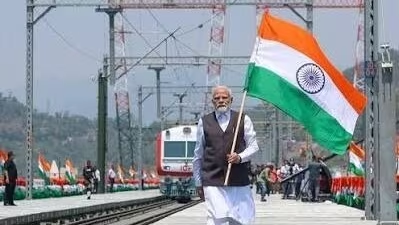
On the 75th Independence Day, Prime Minister Narendra Modi introduced ‘Paanch Prans’ (five pledges), which included the clarion call for the removal of the colonial mindset that plagues Indian society. Tomorrow, we celebrate the 80th Independence Day, with the nation defying the doomsday sayers and moving forward towards the 2047 goal of a developed nation.
Remembering the horrors of 1947 Partition, where no less than two million Indians were slaughtered, PM Modi today took to X to remind the citizens that only cowards leave their future to fate, while asking the countrymen to contribute to the nation’s growth through courage, enterprise, persistence and hard work.
symbols of most ruthless conquerors of India’s dark past are still celebrated in the name of diversity and inclusivity While the Centre and the BJP ruled state governments have made efforts to remove traces of colonial servitude since the five pledges. One of the biggest symbols of the colonial past is the Indian bureaucracy, which has been the slowest to reform itself and continues to increase the cost of doing business in India through lethargy and, more often than not, corrupt practices. Only PM Modi has the will and determination to do so, as his political base still rocks. With rising India facing challenges and hurdles from both the democratic US and Communist China, the country needs decisive reforms, not endless debates and never-ending protests, for a better future. After making Pakistan into a supplicant state, China has made very serious inroads into Bangladesh, Nepal, Myanmar and Sri Lanka in order to throttle India and curtail its global ambitions. The West is no different, as the Anglo-Saxon policy of supporting Pakistan and generating discontent within India has not changed. India’s dark and horrid past alone should ensure that impotent politics and colonial mindset are thrown out into the Bay of Bengal.
If India wants to achieve the 2047 dream of a developed country, a total overhaul of Indian bureaucracy is required, as the corrupt must be thrown out and merit must be rewarded. Hard decisions are required to make India an industrial-military power, as its main adversary is its northern neighbour with an ever-festering boundary dispute, triggered by the Chinese occupation of Tibet in 1950. Some of them still occupy free rent space as the foundation of public policy even today, particularly in education and the social sector.
