
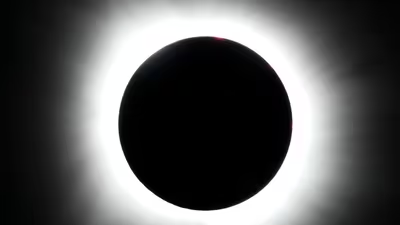
The August 12, 2026, solar eclipse will occur today in a few hours, giving skywatchers across the Northern Hemisphere a rare celestial event. But for people in the US, the view depends on where they live.
A solar eclipse happens when the Moon moves between the Sun and Earth, blocking some or all of the Sun’s light from reaching Earth.
What Happens Next
NASA says the August 12 eclipse will bring totality to parts of Greenland, Iceland, northern Russia, Spain and a small part of Portugal. But you can watch NASA’s live coverage at 1:15 p.m. EDT on August 12.
Because totality occurs somewhere along its global path, nASA lists these timings: The eclipse is called a total solar eclipse. The amount of the Sun that appears covered depends on where you are standing. People inside the Moon’s darkest shadow can see a total eclipse, while those farther away see only a partial eclipse. Parts of the northern US will see only a partial eclipse. The path of totality is the narrow strip of Earth where the Moon completely covers the Sun during a total solar eclipse. The Moon’s shadow has a darker inner region called the umbra and a wider outer region called the penumbra. The umbra creates the path of totality. People outside that narrow path but within the penumbra see only a partial eclipse. NASA’s eclipse map shows the path of totality crossing Greenland, Iceland and Spain, while the partial eclipse extends across a much wider area. That means cities including Los Angeles and San Francisco will not see the Moon pass across the Sun. Alaska is among the best places in the US to see the partial eclipse. During totality, the Moon completely covers the bright face of the Sun, briefly turning day into something resembling twilight.
Totality will last less than two minutes for most people along the path, although it can last slightly longer near the centre of the eclipse path, according to NASA.
