
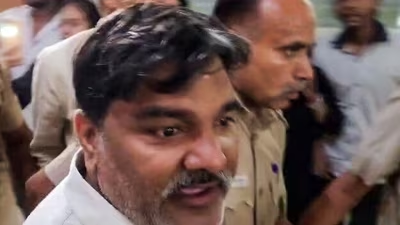
A Delhi court, which sentenced former Aam Aadmi Party (AAP) councillor Tahir Hussain and four others to life imprisonment for the murder of Intelligence Bureau (IB) official Ankit Sharma during the 2020 Delhi riots, observed that the crime was committed solely on the basis of religion and described it as “horrendous” and “sickening.”
Event Context
“The manner and the utmost brutality with which the victim was killed was done solely on account of religion. He was sucked in by the murderous mob baying for blood and dragged like an animal till Chandbagh Pulia. The attack was fierce and unrelenting,” the court observed orally.
The court added that the crimes committed were in utter disdain of law and disregard for life. “The incident was horrendous and nauseating and sickening.”
Hussain and four others were awarded life imprisonment in connection with the murder of Intelligence Bureau (IB) official Ankit Sharma during the Northeast Delhi riots in 2020.
The order was pronounced by additional sessions judge Parveen Singh of the Karkardooma courts.
On July 13, a Delhi court had convicted Hussain and four others for Sharma’s murder, holding that Hussain, along with an “armed” mob, had carried out a “savage” and “relentless” attack.
The court held that the prosecution had proved beyond reasonable doubt that Hussain was part of an “unlawful assembly which, with animus against Hindus, had assembled at Chand Bagh Pulia with a common object to commit rioting, loot, arson and to cause damage to Hindus and their properties.”
“Ankit Sharma was abducted and relentlessly assaulted in a hapless manner. A total of 51 injuries were made upon the victim and 18 of them were through sharp-edged weapons. It is not a case where somebody was stabbed once or thrice,” Special Public Prosecutor Madhukar Pandey argued, noting that the accused continued assaulting Sharma even after his death.
The prosecutor added, “The accused were not human beings, they were animals. They did not have respect for the dead and should therefore be kept behind bars and given the death sentence.”
“The nature of weapons used by the accused shows the intent and the diabolical nature of the crime. It was a cold-blooded murder with a deliberate desire. No one carries a heavy cutting weapon without deliberation, akin to a butcher,” the prosecutor submitted.
The Delhi Police had earlier sought capital punishment for Hussain and the four others, describing the killing as “exceptionally brutal”, “cold-blooded” and falling within the “rarest of the rare” category.
“Ankit Sharma was abducted and relentlessly assaulted in a hapless manner. A total of 51 injuries were made upon the victim and 18 of them were through sharp-edged weapons. It is not a case where somebody was stabbed once or thrice,” Special Public Prosecutor Madhukar Pandey argued, noting that the accused continued assaulting Sharma even after his death.
The prosecutor added, “The accused were not human beings, they were animals. They did not have respect for the dead and should therefore be kept behind bars and given the death sentence.”
“The nature of weapons used by the accused shows the intent and the diabolical nature of the crime. It was a cold-blooded murder with a deliberate desire. No one carries a heavy cutting weapon without deliberation, akin to a butcher,” the prosecutor submitted.
Appealing for the death penalty for Hussain and others, the prosecution said the offence fell within the “rarest of the rare” cases, calling it “one of the gravest cases of extreme culpability.” He argued that any punishment less than death would be inadequate.
“Those who seek mercy should also show mercy. No evidence has been brought on record to show that any mercy was shown by anyone to carry the victim to a hospital. Hussain abdicated his responsibility of public service as a councillor,” the prosecution submitted.
To which, Hussain argued, “No person has directly attributed me during the trial, and the court has found no evidence of any criminal conspiracy behind the incident. Injuries are not the criteria to decide the death sentence.”
Team Analysis
As he attempted to pacify both sides, he was allegedly kidnapped, assaulted, and stabbed multiple times by a mob of 20-25 people. His body was recovered the next day from a drain in the area.
Following the court’s order, Hussain said he would seek justice from the Delhi High Court, saying “it’s not too late.”
While being escorted out of the Karkardooma court, Hussain told reporters, “Insaaf High Court se milega (Justice will come from the High Court).” He added, “The High Court will give justice; it is not too late.”
source
According to the prosecution, Sharma was killed in the vicinity of his home in Khajuri Khas on February 25, 2020, after he ran into clashes between two groups in the Chand Bagh Pulia area.
