
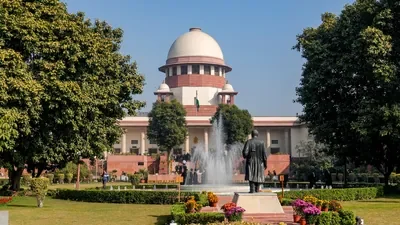
The Supreme Court on Thursday reserved orders on the question whether the law appointing Chief Election Commissioner and election commissioners should be referred for decision by a five-judge bench as Centre objected to a two-judge bench deciding on this issue.
Event Context
The court passed the order while hearing a bunch of petitions challenging the validity of the CEC and EC (Appointment, Conditions of Service and Term of Office) Act, 2023. One of the grounds of challenge was the exclusion of the Chief Justice of India (CJI) from the panel of the Selection Committee laid down by a five-judge Constitution bench decision in Anoop Baranwal, which held the field till the coming of a law.
Also read: Jharkhand SIR: 4.37m may be dropped in draft rolls, over 7 lakh dead voters recorded
The bench of justices Dipankar Datta and Satish Chandra Sharma said, “The judgment on the question as to whether the writ petitions need to be referred to a bench of five judges is reserved.”
The bench, while referring to the law in question, noted that Section 7 of the 2023 Act provides for a selection committee headed by Prime Minister as the Chairperson along with the Leader of Opposition in Lok Sabha and a Union Minister nominated by PM as members. “The question arising before us is whether Section 7 is ultra vires the Constitution. Where is the concluded authority that this is a decided question,” the bench said. Moreover, the Baranwal judgment was to hold the field till Parliament enacts a law.
Prior to reserving orders, the court did put some searching questions to the Centre on the reason why the Parliament chose not to have CJI in the selection panel even as he remained part of the selection process for CBI Director. “Can we question the Parliamentary wisdom for including CJI as part of the selection committee for choosing Lokpal and CBI Director and not for such a high office such as CEC.” The court was informed that CJI is no longer part of the Lokpal selection panel.
Also read: ‘Govt heard, govt delivered’: Raghav Chadha speaks up ‘in support’ of students in Parliament
Solicitor general submitted that Baranwal came prior to the law enacted by Parliament and cannot bind the legislative wisdom in enacting the law. The decision came in March 2023 while the law came into force in December that year. Mehta said that similar to independence of judiciary, independence of legislature is equally part of basic structure of Constitution that cannot be altered by a Constitution bench decision.
Team Analysis
During the arguments in the case, Attorney General R Venkataramani along with solicitor general Tushar Mehta said that since “substantial questions of law” relating to interpretation of Constitution arise for consideration in this case, Article 145(3) of the Constitution requires the matter to be heard by a bench with minimum strength of five judges.
The petitioners, including Congress leader Jaya Thakur, NGO Association for Democratic Rights among others, argued that the law is unconstitutional as it is violative of Article 14 being arbitrary in nature and defeats free and fair elections promised under Article 324 of the Constitution. A battery of senior advocates representing them argued that the Anoop Baranwal judgment has already decided the substantial questions of law and what remains to be seen is whether the 2023 law has violated those principles.
Also read: US plans $100k fee for foreign graduates seeking jobs; 360,000 Indian students likely to be hit: Report
The court permitted the petitioners to submit their written submissions and said, “If we find there is something to consider in your written notes to be put to the other side, we will bring it back here.”
Match Outlook
Venkataramani said that the Baranwal judgment raises serious issues for consideration as it proceeds on the assumption that prior appointments of CEC and ECs undermined rule of law. “If ultimately, the judgment is so designed that for all practical purposes, the Parliament will have to be gagged, that will be a very serious thing.”
Mehta also raised the trust factor as the petitioners argued that a panel having the PM, Leader of Opposition and a Union Minister cannot be trusted to take independent decisions. The bench clarified, “It is not lack of faith but a tilt they are talking about. Should there be no show of fairness when you are appointing CEC and ECs is what they are asking.”
The petitioners led by senior advocates Vijay Hansaria, Gopal Sankaranarayanan, Shadan Farasat, Sanjay Parikh and advocate Prashant Bhushan gave instances from the past where a challenge to a legislation raising substantial questions of law on interpretation of Constitution came to be decided by a bench of two or three judges.
Also read: Israel-Hamas peace deal: What to know as Trump announces ‘complete disarmament’
The bench told the petitioners, “We are dealing with a specific statute. Whether Parliament conferring authority to the Prime Minister to select a Minister as the third person of the selection committee — that question has not been answered.” While Baranwal proposed the selection panel headed by the PM along with the Lok Sabha Leader of Opposition and CJI, the law replaced CJI with a Union Minister.
