
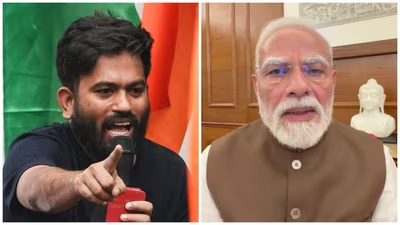
Cockroach Janta Party (CJP) founder Abhijeet Dipke took a swipe at Narendra Modi after the Prime Minister released a video message welcoming Parliament’s passage of the Public Examinations (Prevention of Unfair Means) Amendment Bill, 2026.
Latest Update
The legislation was introduced after fresh paper leak allegations this year which led to massive student protests and eventually led to the resignation of Dharmendra Pradhan as education minister. Pralhad Joshi later took charge of the ministry.
ALSO READ | ‘Leave the chair, become an influencer’: CJP’s Abhijeet Dipke takes swipe at PM Modi; questions anti-paper leak bill
Before Parliament passed the legislation, the CJP had criticised the proposed amendments and said that they focused more on punishing offenders after a paper leak than preventing such incidents.
In a video message on X during the earlier parliamentary debate, CJP national spokesperson Ashutosh Ranka said the bill did little to address the systemic flaws that enable examination leaks.
“You have been talking about everything after the paper leak, whether it is fast-track courts, harsher punishments or penalties. But you have not talked about what you are doing to stop paper leaks,” Ranka said.
The Prime Minister has now released four selfie-style videos addressing the paper leak issue, with Thursday’s message being the latest in the series.
Dipke’s latest jibe adds to a series of attacks by the CJP on PM Modi’s recent social media outreach. A day earlier, he had suggested that Modi quit as prime minister and become a social media influencer instead.
“I think [PM Modi] should become an influencer. He is doing very well at that. If he is such a good influencer, then he should leave the Prime Minister’s chair, become an influencer, and let someone else do the job,” Dipke told reporters in his hometown in Maharashtra on Wednesday.
His remarks supported criticism made by Congress MP Priyanka Gandhi in Parliament earlier this week, when she said, “You can’t get Gen Z’s support by making videos from new angles. The PM has to change the angle of his heart, not the camera angle.”
Details
In the selfie-style video posted on Thursday, PM Modi called the legislation a major step towards creating a credible examination system and said that the “paper mafia” would not be spared. He also said the government would continue reforming the examination system through technology and stricter laws.
ALSO READ | PM Modi back with a selfie video, hails passage of stricter anti-paper leak bill
On Instagram, Dipke commented, “Your skin is brighter than the country’s future.”
The comment comes amid an ongoing confrontation over recurring examination paper leaks. The CJP has been at the forefront of protests demanding systemic reforms, accountability and action against those responsible for repeated exam irregularities.
The anti-paper leak bill, passed by both Houses of Parliament this week, strengthens the 2024 law by increasing prison terms and fines for examination fraud, mandating time-bound investigations and requiring states to set up fast-track courts for paper leak cases.
He asked the Centre to prioritise structural reforms, including overhauling the National Testing Agency (NTA) and increased transparency in examination schedules.
Dipke, on Wednesday, told reporters, “I think bills will keep coming, but until the intentions of these people are right, nothing can happen. Many good laws have been made in this country through reforms. One law after another gets passed here.”
Referring to the government’s proposed fast-track courts for paper leak cases, questioned the implementation of the reforms.
“Narendra Modi had promised a fast-track court three days ago, and people were very happy, thinking there would be a fast-track court for paper leak cases. But what happened? The very first hearing itself was postponed because the CBI’s counsel did not show up. So you can make whatever laws you want, but until the people implementing them are good, what is the point of those laws?” he said.
ALSO READ | CJP slams anti-paper leak bill: ‘Focuses on punishment rather than prevention’
