
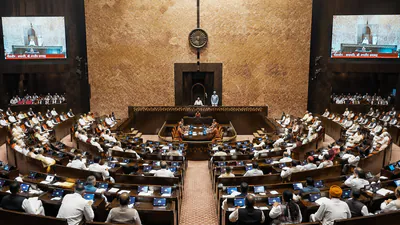
The Rajya Sabha on Thursday debated the Public Examinations (Prevention of Unfair Means) Amendment Bill, 2026, a day after it was okayed by the Lok Sabha. The bill, once passed by the Upper House too, will be sent to President Droupadi Murmu for assent before it becomes law.
Latest Update
Kharge also alleged that the government introduced the amendments to pacify protesting students and criticised its handling of recent student protests.
Samajwadi Party chief Akhilesh Yadav said the amendments were brought under pressure from student protests and claimed paper leaks continued in BJP-ruled states.
“This law existed in 2024 as well… The new law enacted for 2026 came about under pressure–when large numbers of students took to the streets,” he said.
SP MP Dimple Yadav said the amendments would not address the root cause of recurring paper leaks.
ALSO READ | ‘Amit Shah gave firing order’ vs ‘No shots fired’: Rahul Gandhi, Centre in war of words as anti-paper leak bill passed
BJP MP Dinesh Sharma called the bill “historic” and accused the Congress of avoiding a meaningful debate. “This is a historic event… It is unfortunate that the Congress was shying away from the discussion,” he said.
JMM MP Mahua Maji said transparency and accountability should be prioritised. She also said that harsh laws should not end up penalising innocent people.
The Lok Sabha passed the proposed legislation on Wednesday after a debate. The government describing it as a major step to curb examination fraud and restore confidence in the public examination system.
Details
Tabling the bill on Wednesday, Union minister of state Jitendra Singh said the amendments showed the government’s willingness to “learn from experience” and strengthen the anti-paper leak law enacted in 2024. The legislation tightens penalties for examination-related fraud, introduces time-bound investigations and trials, and creates a framework for Special Task Forces and Fast Track Courts to deal with organised examination crimes.
ALSO READ | ‘First of kind’ vs ‘showpiece amendment’: Fiery paper leak bill debate in Parliament
The amendments retain the core framework of the Public Examinations (Prevention of Unfair Means) Act, 2024, under which offences are cognisable, non-bailable and non-compoundable, while candidates themselves remain outside its ambit.
-Punishments and timelines have been significantly strengthened. Individuals convicted of using unfair means will now face five to 10 years’ imprisonment, up from three to five years earlier.
– The maximum fine has been increased from ₹10 lakh to ₹50 lakh.
-Service providers found guilty can be fined up to ₹5 crore, compared with ₹1 crore earlier.
-They will also be barred from conducting examinations for eight years instead of four.
-For organised examination fraud, the minimum jail term has been increased from five to seven years. Fines imposed will be up to ₹10 crore.
-The bill also mandates investigations be completed within two months of referral by the Centre and requires states and Union Territories to establish fast-track Courts to end trials within three months of filing the chargesheet.
ALSO READ | Lok Sabha clears anti-paper leak amendment bill: 10-yr jail, ₹50L fine, faster probes and trials -What it will change
Leader of Opposition in the Rajya Sabha Mallikarjun Kharge said stricter punishments alone would not stop paper leaks. He said that reforms in the examination system and institutional accountability were needed.
“What would make a difference is how the government conducts these examinations,” he said, “Paper leaks hurt innocent students and their parents.”
