
The Karnataka State AIDS Prevention Society (KSAPS) has denied reports of HIV testing being made mandatory in colleges across the state. The KSAPS also rejecting media reports that claimed 7,000 college students in Karnataka had tested HIV positive.
Latest Update
In a press release dated July 29, KSAPS said the reports were based on a “wrong interpretation” of official data and requested media organisations to publish the clarification to prevent misinformation.
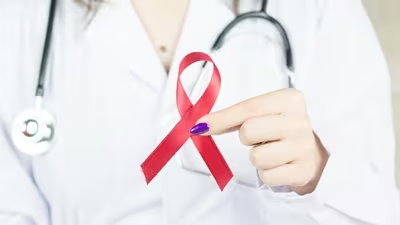
The clarification comes amid the rollout of the Mobilisation for AIDS Suraksha (MAS) programme, an eight-month Red Ribbon awareness campaign aimed at educating college students and the public about HIV prevention.
ALSO READ | HIV progress in ‘real danger’ as global funding plummets
KSAPS said the state has launched the Mobilisation for AIDS Suraksha (MAS) programme to curb the spread of HIV and raise awareness among college students through an eight-month Red Ribbon Awareness Campaign.
ALSO READ | Train the cell, then deploy: Science behind the new HIV study, and why it’s a foothold, not a finish line
“From 2004 till date, 39,028 infected people of age group between 18 and 35 years have been receiving ART treatment. However, it has been wrongly interpreted by the media that 7,000 college students have been infected with HIV,” the press release said.
ALSO READ | New HIV infections, AIDS deaths hit 30-yr low, but world remains off track: Reports
No mandatory HIV testing in colleges
As part of the initiative, the public is being encouraged to scan the breakfreeindia.org HIV Self Risk Assessment QR code to assess their risk. Those identified as being at risk are advised to undergo HIV testing.
The agency said that the initiative was voluntary. “According to the HIV and AIDS (Prevention and Control) Act, 2017, HIV testing cannot be made mandatory and so it has not been made mandatory,” KSAPS said in the statement.
It added that scanning the QR code allows users to assess their HIV risk and provides information on the nearest Integrated Counselling and Testing Centre (ICTC) for confirmatory testing, if required.
KSAPS clarified that media reports incorrectly interpreted treatment data as referring to college students. The society said that 39,028 people aged between 18 and 35 years had been receiving antiretroviral therapy (ART) since 2004, but this figure was wrongly reported as meaning that 7,000 college students were infected with HIV.
The clarification follows concerns raised by KSAPS over the state’s HIV burden. According to the National AIDS Control Organization’s (NACO) “Sankalak – Status of National AIDS & STD Response 2024” report, Karnataka ranks third in India in the number of people living with HIV.
The state currently has an estimated 2.60 lakh people living with HIV, of whom around 2.05 lakh are receiving antiretroviral therapy (ART). KSAPS estimates that around 54,000 people remain undiagnosed and are unaware of their HIV status.
The society has also flagged a rise in infections among people aged 18 to 35 years. According to KSAPS data, the number of people living with HIV in this age group increased from 44,500 in 2023-24 to 66,600 in 2025-26.
As part of its HIV prevention strategy, KSAPS has written to the Visvesvaraya Technological University (VTU) and the Department of Collegiate Education seeking permission to organise Integrated Health Camps (IHCs) for HIV counselling and testing in government, aided, private and engineering colleges.
The proposal is aimed at achieving the 95-95-99 HIV control targets.
Under the programme, the first “95” target seeks to ensure that 95% of people living with HIV know their status, followed by linking 95% of those diagnosed to treatment, while the final target aims to achieve 99% viral suppression.
