
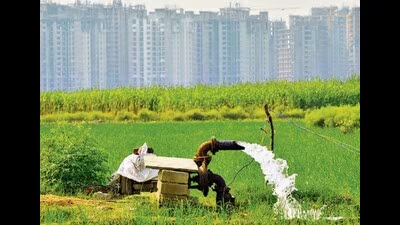
Despite multiple initiatives to conserve groundwater, Haryana continues to overexploit its aquifers, extracting 136.75% of its annually replenishable groundwater, more than twice the national average of 60.63%.
Event Context
Punjab remains the country’s most groundwater-stressed state with extraction at 156.36%, followed by Rajasthan at 147.11%.
The report shows Haryana’s Stage of Groundwater Extraction (SoE), which is a measure of annual groundwater extraction for all uses irrigation, industrial and domestic uses- stood at 136.75%. The figure is marginally lower than 136.91% in 2017, but slightly higher than 135.96% recorded in 2024, indicating that while the decline has been arrested, there has been little meaningful improvement over the past eight years.
The Haryana agriculture department had introduced several cash incentive schemes under the Mera Pani Meri Virasat programme, but the data indicates that Haryana’s groundwater extraction has declined by just 0.16 percentage points since 2017. In contrast, Punjab recorded a decline of 9.41% over the same period.
Nationally, groundwater extraction declined from 63.33% in 2017 to 60.63% in 2025, reflecting an overall improvement of 2.70 percentage points.
Experts attribute Haryana’s groundwater stress primarily to the paddy-wheat cropping cycle, heavy dependence on tubewells for irrigation, rapid industrialisation, expanding urban centres and inadequate natural recharge.
The Centre told Parliament that groundwater management is primarily the responsibility of state governments, but it said multiple measures have been taken to improve recharge and regulate extraction. CGWB has also prepared the Master Plan for Artificial Recharge to Groundwater- 2020 for the entire country and shared it with states and UTs.
source
According to the 2025 groundwater assessment, tabled in the Rajya Sabha by the Union Ministry of Jal Shakti, Haryana remains the country’s third-most groundwater-stressed state, after Punjab and Rajasthan and continues to be classified as an ‘over-exploited’ state.
The SoE measures annual groundwater withdrawal as a percentage of the annual extractable groundwater resource. Any value above 100% indicates groundwater is being withdrawn faster than it can be naturally recharged, placing the area in the over-exploited category.
Several districts in central and northern Haryana have long been classified as over-exploited owing to continuous groundwater withdrawal. According to the ministry of jal Shakti, the groundwater resources are jointly assessed by the Central Ground Water Board (CGWB) and state governments every year. According to the Ground Water Resource Estimation (GWRE) 2024 report, out of the state’s 143 assessment blocks, 88 have been classified as “over-exploited”, where groundwater extraction exceeds the annual recharge. Besides these, 11 blocks fall in the critical category, eight are semi-critical, and only 36 are classified as safe.
The CGWB report shows that 111 blocks out of 153 in Punjab have been categorised as ‘over-exploited.’ Additionally, 10 blocks are classified as critical, 15 as semi-critical and 17 are in the safe category.
