
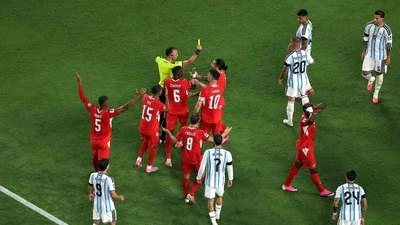
The FIFA-backed International Football Association Board (IFAB), which oversees football’s laws, has conceded, more than a week after the end of the World Cup 2026, that Switzerland striker Breel Embolo should not have been sent off in the quarterfinal clash against Argentina, admitting that the controversial call dramatically altered the course of the game.
Event Context
After falling behind in the first half, Switzerland produced a spirited attacking display after the break, relentlessly exposing an Argentina defence that struggled to contain the pressure. Their persistence was rewarded when they deservedly found the equaliser. The European side, appearing in its first World Cup quarterfinal since 1954, continued to push the 2022 champions back until Embolo’s dismissal in the 72nd minute changed the complexion of the contest.
The 29-year-old forward went down following a challenge from Leandro Paredes, with referee Joao Pinheiro initially booking the Argentina midfielder for the tackle. However, after a VAR intervention suggested that Paredes had not committed a foul, the referee overturned the decision and instead booked Embolo for simulation, resulting in his second yellow card and subsequent dismissal.
The controversial red card triggered widespread criticism. Earlier in the Round of 16, Argentina’s opponent, Egypt, had claimed that refereeing decisions throughout the tournament had appeared to favour Lionel Messi’s side.
IFAB, which consists of FIFA representatives and members from the four British football associations, issued a clarification on Monday, stating that the VAR protocol for “mistaken identity” situations did not apply to incidents such as Embolo’s dismissal at the World Cup. However, the governing body said the possibility of expanding the review process could be considered in future competitions.
“The use of the mistaken identity clause to deal with simulation during the FIFA World Cup 2026 was well received and will be included in the detailed review of the VAR protocol… however, it may not be used as such until that review is concluded.”
Player Focus
The incident came just before the second hydration break and proved to be a defining moment. Despite being reduced to 10 players, Switzerland fought desperately to stay alive, defending wave after wave of Argentina attacks before eventually conceding in extra time to lose 3-1.
“A yellow card (caution) which is not a second yellow card can only be reviewed to identify the player who committed the offence that was penalised; the offence itself cannot be reviewed / changed,” IFAB said.
Team Analysis
Argentina eventually reached the final, where their title defence ended with a 0-1 defeat against Spain on July 19 in New York.
“The referee made the wrong decision,” Switzerland coach Murat Yakin said after the match in Kansas City.
“I know they will protect their referee, but this rule destroyed our game today. It is very painful, and to be eliminated in that way hurts a lot.”
