
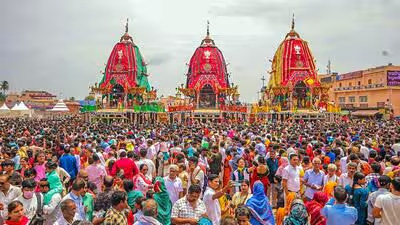
The Supreme Court on Tuesday said its earlier decision to allow the release of the animated film ‘Mahaprabhu Jagannath’ only after the conclusion of the Rath Yatra was intended to balance concerns over law and order with the fundamental right to free expression. The court also agreed to list an application filed by the Shree Jagannath Temple Administration on Wednesday challenging the film’s release.
Event Context
A day after Chief Justice of India Surya Kant assured the temple administration that the matter would be heard on Tuesday, the application was not listed. Odisha advocate general Pitamber Acharya mentioned the matter before a bench headed by justice BV Nagarathna, which had passed the July 17 order permitting the film’s release after the Rath Yatra, and sought an urgent hearing.
Justice Nagarathna observed that the court had consciously deferred the release until after the festival in view of public sensitivities.
“We had permitted the release of the movie after the conclusion of Rath Yatra as we had to balance everything. We are conscious about the sensitivities attached to law and order. So we permitted the release after the festival gets over,” the bench said.
Appearing for the Odisha government, Solicitor General Tushar Mehta informed the court that the temple administration had approached the Central Board of Film Certification (CBFC) on July 25 seeking revocation of the certification granted to Mahaprabhu Jagannath.
Mehta submitted, “If the CBFC has to take a decision, it cannot do so as this court has ordered the release of the movie.”
Acharya told the bench that the petition challenging the contents of the film remains pending before the Orissa high court and is scheduled to be heard on August 5. He clarified that the temple administration was only seeking a clarification that the Supreme Court’s July 17 order dealt solely with the timing of the film’s release and did not decide the merits of the challenge. He urged the court to allow the high court to adjudicate the pending petition.
The bench, however, remarked, “You are now expanding the scope of the petition. This is only a cartoon. It will appeal more as its fictional work. We balanced the rights of liberty of the producer and the sensitivity involved and permitted the movie’s release after the Rath Yatra gets over.”
Mehta suggested that the application be formally listed so that the temple administration could place its concerns before the court. Accepting the request, the bench agreed to list the matter for hearing.
In its application, the Shree Jagannath Temple Administration submitted, “There is presently a state-wide agitation against the release of the film in the form of protest demonstrations, processions, public meetings, representations and calls for closure of exhibition of the film in cinema halls across the state of Odisha.”
Senior advocate Devadatt Kamat, appearing for producer Ele Animations Private Limited, opposed the application, contending that it was effectively seeking a review of the court’s earlier order.
“What kind of a government are they running if law and order is being cited as a reason to deny exhibition of a film which has received CBFC certification,” Kamat argued.
The temple administration further argued that although the Rath Yatra had concluded, lakhs of pilgrims continued to remain in and around Puri and were travelling across Odisha. It urged the court to restrain the film’s release until either the High Court or the CBFC takes a final decision.
The Supreme Court’s July 17 order was passed on a petition filed by the producer challenging an interim order of the Orissa high court staying the film’s release. The High Court had passed the interim order on a plea filed by Mahesh Kumar Sahu, who alleged that the film’s portrayal was contrary to the Skanda Purana, the Brahma Purana and long-established traditions associated with the Jagannath Temple.
The producer has maintained that Mahaprabhu Jagannath is a fictional animated film centred on a child named Balram, a devotee of Lord Jagannath. The producer also submitted that the story had been aired successfully as a television series for the past two years.
While staying the release earlier, the high court had observed that films are a powerful medium of expression and, particularly in matters involving religious faith, their impact on the public must be carefully assessed. It held that the freedom of expression guaranteed under Article 19(1)(a) of the Constitution must be balanced against the reasonable restrictions under Article 19(2), and cannot be exercised in a manner that hurts religious sentiments or disturbs public order.
source
Mehta responded that the court had not viewed the film. He said a pre-release screening had been organised for the temple administration, which had recommended certain changes. According to him, the grievance was that the film was released without incorporating those suggested cuts.
