
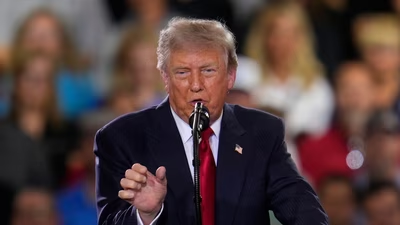
Oil extended a steep decline after President Donald Trump said that the US and Iran were engaged in talks to try to end the Middle East conflict, with the two sides continuing to hold off on attacks.
Market Context
Global benchmark Brent fell toward $87 a barrel after losing 8.7% on Monday, the most in more than three months. West Texas Intermediate was near $81.
President Trump said he decided to pause strikes to give negotiations another chance, according to Axios. He also said there was a “good chance” talks would make progress, in remarks to reporters aboard Air Force One. Still, it remains unclear if any substantial discussions were taking place.
Watch | Mojtaba names new ‘enemies’: Did US allies in Gulf quietly open their bases for brutal Iran strikes?
Crude has been whipsawed this month, initially surging as hostilities between Washington and Tehran re-escalated and the war spread to the Red Sea, then slumping when tensions eased in recent days. Still, traders remain cautious as tanker traffic through the Strait of Hormuz has yet to normalize.
“I don’t think the Middle East is ‘solved’,” said Scott Shelton, energy specialist at TP ICAP Group Plc. There needs to be “real evidence of oil moving through the Strait of Hormuz, which I think has yet to happen,” he added.
Later Tuesday, President Trump is scheduled to meet Israeli Prime Minister Benjamin Netanyahu in Washington for talks over Iran. The two nations launched the war in February in a push to thwart Tehran’s nuclear program.
In the Middle East, negotiators from Iran and Oman are trying to reach a deal to restart shipping through Hormuz, which links the Persian Gulf to global markets and used to carry a fifth of daily oil flows in peacetime.
Supply disruptions eased elsewhere, as Kazakhstan’s main terminal resumed loadings after Ukrainian drone attacks had disrupted exports. Two tankers began loading at the Caspian Pipeline Consortium facility near the Russian port of Novorossiysk, the Kazakh energy ministry said.
Future Forecast
Macquarie Group Ltd. warned a glut was likely to return before the end of year as Washington faced mounting pressure to end the Iran conflict. As soon as a deal was reached, the oil market would be “significantly” oversupplied, with a daily surplus of 2 million barrels expected in the fourth quarter, it said.
Source
Observable traffic through Hormuz was muted early on Tuesday, though some vessels appeared to have sailed through without their transponders on. A day earlier, only four vessels crossed, Kpler data show. Some 25 commodity vessels transited Bab el-Mandeb on Monday, including several carrying Russian oil cargoes through the Red Sea, according to Kpler.
Iran and Oman, which border the strait, are continuing discussions after their officials met in Tehran over the weekend, according to people familiar with the matter. A successful deal would then enable the Islamic Republic and the US to resume talks over ending their war, they said.
Iran’s army said it halted retaliation against US bases and troops in the region as a result of Trump’s decision to hold off on strikes. The Islamic Republic had been attacking the likes of Kuwait, Bahrain and Jordan on a near-daily basis in the two weeks before the US pause on Friday.
