
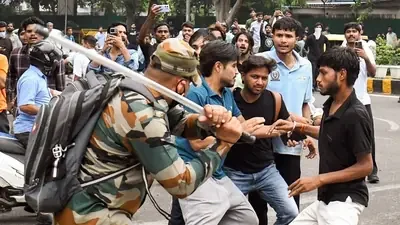
The use of force during the Cockroach Janta Party (CJP)’s march to Parliament, which descended into chaos last week, was the culmination of “unauthorised escalation, repeated warnings, barricade breaches, vehicle damage, and continued unprovoked heckling of both police and the press”, security officials familiar with the developments said.
Event Context
A review is underway to examine whether the graded police response was correctly calibrated at each stage, the role of “disruptive elements” distinct from the genuine protester body, and any lapses by law enforcement personnel that may warrant scrutiny, the officials said. While acknowledging that the use of force was “a matter of record”, they insisted it was neither isolated nor unprovoked.
Amid criticism over alleged police excesses, the officials said the review into the July 20 violence was “evidence of institutional self-examination, rather than an afterthought following criticism”. They also laid out the sequence of events leading up to the clashes, saying it was necessary “to place the day’s events in their full context”, while acknowledging injuries suffered by protesters.
“The sanctioned assembly was a sit-in at Jantar Mantar, a designated protest site. No permission existed for a march toward Parliament or any route beyond the sanctioned perimeter,” one of the officials said.
“The flashpoint was not the protest itself, which the police facilitated for weeks, but an unauthorised march toward a high-security zone during an active Parliament session,” he added.
The official said police did not attempt to forcibly remove protesters who had been demonstrating at Jantar Mantar for about a month despite indications that “elements identified as unconnected to the genuine student or protester body” had infiltrated the protest over the alleged NEET paper leak.
The official alleged that police vehicles were damaged, senior and elderly police personnel were surrounded, jostled and heckled, while media personnel faced hooting and heckling. He also cited instances of “physical as well as sexual harassment”.
Police initially held multiple layers of iron barricades, but sections of the crowd dismantled them and attempted to enter restricted zones, he said.
“First, police responded by pushing the crowd back and, in some instances, used water cannons,” the official said. As the crowd continued “damaging barricades, throwing stones, and heckling or attacking personnel”, police issued final warnings before escalating their response.
Player Focus
“Thereafter, police authorised a graded use of force: a targeted lathi-charge against identified aggressors, or tear gas released in controlled bursts, aimed specifically at those breaching lines or attacking personnel rather than the crowd as a whole. Force was withdrawn once the immediate threat was neutralised,” the official said.
“The fact that the site did not descend into a wider law-and-order breakdown, despite injuries to personnel, reflects a deliberate choice by the force to prioritise containment and calm over retaliation,” he added.
source
According to an internal Delhi Police report submitted to the government, more than 100 people facing murder charges and hundreds accused in robbery, sexual offences, Arms Act and narcotics cases were identified through facial recognition technology during the violence at the CJP’s march to Parliament.
On the day of the march, police repeatedly issued verbal announcements and requests asking protesters not to proceed towards Parliament, the official said.
“Despite this, sections of the crowd—mixed in with genuine protesters—pushed toward barricaded, high-security zones in the vicinity of Parliament, and barricades were breached in succession,” he said.
