
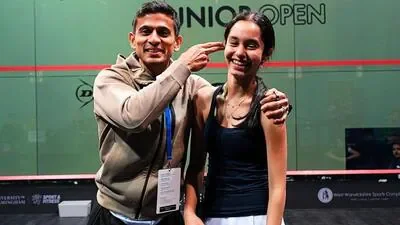
Mumbai: Anahat Singh is now a world junior squash champion—the first Indian and the first non-Egyptian woman since 2010 to sit on the throne. And yet the celebrations, by the Niagara Falls where she’s presently, have to be put on ice.
Event Context
For four years, the country’s most decorated and one of the world’s most promising young squash talents kept turning up at the junior worlds, and kept falling short. Three quarter-finals meant she stood a step away from a medal, and one semi-final last year meant she had a bronze but not what she was after.
That, despite rapidly growing in stature on the senior professional tour, shooting up to the top-20 of the PSA rankings, gobbling up 16 PSA titles and being an Asian Games medallist. Why, then, did a junior title still matter so much to her?
“I mean, it’s still the world juniors,” Anahat told HT on a Zoom call from Ontario, Canada, two days after finally standing on top of the podium with a win over Egypt’s Ruqayya Salem in the final.
“It’s the biggest event for any junior, and I was still a junior whether I was playing the seniors or not. This was also my fifth year playing, and I would always lose coming really close to it. I wanted to break that, and show that I can win this event. It’s something that I wanted to tick off, and something I wanted to be satisfied with—that I’ve ended my junior career well.”
There was almost a sense of desperation in her around chasing that one medal. Would desperate be the right term?
“Yeah, definitely,” Anahat said. “I wanted this badly.”
How does a teenager mentally handle something she wants so desperately?
It wasn’t quite working. In her quarters and semis, Anahat felt she did not play too well, “because I was getting too stressed out”. Long conversations with her mentor Saurav Ghosal, who was with her in Ontario, before and on the day of the final eventually eased her out.
“He was like, ‘You’re playing really badly. This is not how you need to be playing. If you really want to win tomorrow (final day), just go all out. Don’t think about the outcome, don’t think about anything else. You have the game to beat everyone in this event’,” Anahat recalled Ghosal’s words on the Zoom call.
“So, having that conversation with him, being able to focus on playing my game, and just remembering that I’ve played against the top-10, top-20 players. And if I’m able to beat them, I can play a lot better here. That mentality just helped me a lot more. In the final, I wasn’t stressed at all, I’d say maybe 10%. I was playing freely, and just enjoying every moment on court.”
What also gave her more confidence was playing more tournaments on the PSA tour. Anahat won the JSW Indian Open in March this year, before taking a short break to appear for her 12th grade exams. On her return, she lost in the first round of the British Open. That “did put a few doubts in my mind” about her junior worlds conquest, before a 15-day training block in Prague with coach Gregory Gaultier shooed it away.
“I knew that I can completely reset the whole thing. I was playing in training, and felt quite good coming into this event. The stakes of it being my last shot, the whole adrenaline of the situation just added up to it.”
The biggest chapter of this year, however, still awaits. The Asian Games has much higher stakes, the cherry being a spot at the 2028 Los Angeles Olympics for the gold medallist. This title helps in adding a bit of belief, but Anahat also knows they are two different worlds.
“It definitely does help a bit, but I wouldn’t say it does too much,” she said. “It makes me happy. It gives me confidence that I can play well and do well at the top stage. But, this was the juniors, and that is the seniors. The situation is very, very different.”
Which is why after a few days of enjoying this triumph, Anahat will go right back into training, “to make sure I’m at my peak at the Asian Games”.
“Right now, the Asian Games is the most important event of my life. So I have to put in 100% for that, and, hopefully, it can all work out for the good.”
Player Focus
At one point during the last couple of years, the thought that maybe she was not meant to get that title, that maybe it was time to set new goalposts, did cross her mind. But she also knew that all she needed was one last shot. She hit bull’s-eye with it, and is now freer in the mind.
“Had I lost this event, I would have been a bit unsatisfied—that I have kept playing juniors for the last 8-10 years, I’ve been doing decently well but I’ve not ended it on a good note,” she said.
“I think this helps a lot in my transition as well into the seniors. It gives me the confidence going into it that one chapter is closed, it was closed well, and I can start off this one well.”
Team Analysis
The team events follow the individual competition, and Anahat has been asked to remain in the competitive zone a bit longer.
“I’ll save the celebrations for the last day,” she says, smiling.
Given how long the 18-year-old has waited to grab the title, a handful of days may feel like nothing in comparison.
Match Outlook
“I mean, I didn’t handle it very well for the last few years,” Anahat admitted. “I knew this was my last chance, and there was literally no going back from this. So I had to just focus, and stay in it. I knew I was ranked 1 (top seed) in this event, and I was expected to win.”
Speaking earlier in the day in a media interaction organised by SAI, Anahat said she felt “a little bit of extra pressure” coming into this edition knowing it was her last chance. From her past faltering experiences, she knew the only way to counter it was to, well, stop thinking about the past.
