
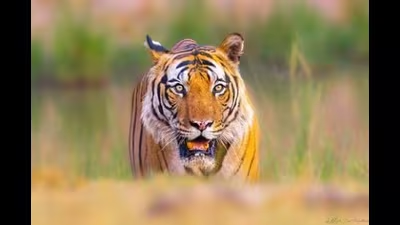
An extensive exercise of camera-trapping big cats, an essential exercise under the quadrennial tiger estimation, has been completed at the Dudhwa Tiger Reserve (DTR) as well as other tiger reserves of the state.
Event Context
Dr H Rajamohan, field director, DTR and nodal officer for the tiger reserves in UP, told Hindustan Times that “around 1,800 cameras had been deployed since December 2025 in Dudhwa National Park, Kishanpur Sanctuary, Katarniaghat Wildlife Sanctuary, Chitrakoot, Pilibhit Tiger Reserve and buffer zones to capture images, and the task was completed by April this year.”
He added that “over 1,50,000 images of tigers, leopards and other wild animals were captured during the exercise and in May, the images were retrieved from the cameras and sent to Wildlife Institute of India (WII), Dehradun, for further analysis to assess the number of tigers.”
When asked about estimation of leopards, Dr Rajamohan said, “While tigers are individually identified with exact precision through their stripes, precise estimation of leopard population is not possible due to their rosette patterns and spots.”
However, he added that a rough estimate of leopards as co-predators has always been mentioned simultaneously along with the tiger estimation.
Rajamohan informed that “during the 2022-tiger estimation, 90 leopards were estimated in the Dudhwa Tiger Reserve (DTR).”
Dudhwa’s rich ecosystem, marked by dense sal forests, tall grasslands, and rich prey base, provides a premier habitat for apex carnivores.
In the 2022-tiger estimation, Dudhwa recorded 153 tigers and was ranked fourth in the country.
The frequent sightings of tigers and leopards in and around Dudhwa including the buffer zone indicate further growth in their numbers.
DEO KANT PANDEY
