
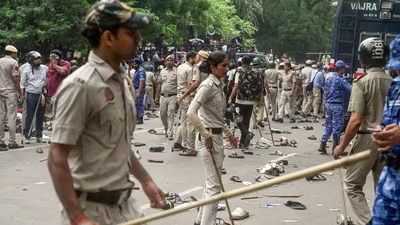
The Bharatiya Janata Party (BJP) on Monday criticised what it called “selective outrage” over the treatment of journalists during recent protests linked to the NEET paper leak at Delhi’s Jantar Mantar, stating that there can be “no justification” for targeting members of the media.
Latest Update
The remarks came just days after education minister Dharmendra Pradhan resigned amid a row over NEET paper leak. The paper leak had sparked a massive student protest in New Delhi’s Jantar Mantar.
Also read – The faces of CJP movement that drove big change: Boston graduate, IITian, JNU scholar, investigative journalist
The BJP leader further said that such debates were not new and referred to what he described as longstanding perceptions of proximity between sections of the media and political establishments. He said that while platforms and individuals may have changed over time, “the ecosystem, incentives and alignments” remained similar.
He also called for consistent standards when assessing media independence. “If media independence is the standard, it should apply consistently to everyone, not just those one happens to disagree with,” Malviya said.
The NEET-related protests, which were started by the Cockroach Janta Party (CJP), saw participation from student groups and political organisations, with demands ranging from accountability over alleged exam irregularities to broader reforms in the examination system.
Also read: The volunteers who kept the stir running at Jantar Mantar
The Public Examinations (Prevention of Unfair Means) Amendment Bill, 2026 is expected to be introduced in the Parliament on Monday. The bill is aimed at strengthening the legal framework against paper leaks and other unfair practices in public examinations.
Details
BJP IT cell head Amit Malviya, in a post on X, said that some journalists were targeted during the protest, with women journalists subjected to sexual abuse. “What happened to some journalists at the protest was unacceptable. A few were targeted, and women journalists, in particular, were subjected to vile sexual abuse. There can be no justification for that,” he wrote.
Amit Malviya, however, also raised concerns about what he described as differential treatment of journalists at the protest site. He said that while some media personnel were abused and labelled, others appeared to be treated as part of the protest environment rather than as independent observers.
“At the same time, it is equally evident that another section of the media was treated as part of the spectacle rather than as independent observers. They appeared to enjoy the confidence of the protesters while others were branded and abused,” he said.
Referring to the use of the term “godi media” – a phrase often used by critics to describe media outlets seen as close to the government – Malviya questioned whether similar labels were applied to journalists perceived to be aligned with protest organisers or particular political groups.
“If one set is labelled ‘godi’ for allegedly being close to those in power, what label applies to those perceived to be aligned with the organisers or a political ecosystem?” he asked.
As the protests continued for 25 days, Dharmedra Pradhan was forced to step down. Prime Minister Narendra Modi also announced a fast-track court for paper leaks and other unfair practices in public examination.
