
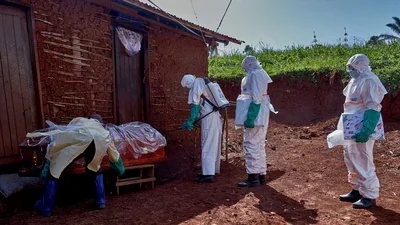
The Ebola outbreak in the Democratic Republic of Congo is poised to become the second-largest on record within days, after 856 new confirmed infections were reported over the past week.
Market Context
The case count climbed to 3,200 on Saturday from 2,344 a week earlier, while the death toll has almost doubled in the past two weeks to 1,405, according to the National Institute of Public Health. The latest figures highlight the scale of the epidemic, though expanded surveillance and retrospective case finding have also contributed to the rapid rise in reported infections.
Congo’s 2018-20 Ebola outbreak — the country’s largest and the world’s second-biggest on record — had reached 2,687 confirmed cases about a year after it began. The current outbreak surpassed that total less than 10 weeks after it was declared.
Also Read: Congo’s Ebola outbreak kills nearly 1,000 people; declared ‘fastest’ in history
Containing the outbreak is proving difficult in a region where population movement, insecurity, artisanal mining and cross-border trade with Uganda and South Sudan continue to fuel transmission.
It’s unfolding across many of the same eastern provinces hit during the 2018-20 crisis — which ultimately sickened 3,470 people, killing 2,287. That toll came despite an unprecedented international response and the deployment of an effective vaccine against the Zaire strain — a tool that isn’t available against the Bundibugyo virus driving the current outbreak.
The United Nations deployed a mobile peacekeeping base near Nyakunde earlier this month after an Ebola treatment center was vandalized, allowing health workers to continue operating in the Ituri town, where 114 cases have been reported. At least a dozen facilities have been attacked since the outbreak began, according to the UN.
Source
About 80% of new cases are now being detected outside known contact lists, underscoring the difficulties health workers face in tracing transmission and containing the outbreak, according to Physicians for Human Rights.
Those challenges are playing out in hospitals and clinics across Ituri, the province at the center of the outbreak. A doctor in provincial capital Bunia told the humanitarian organization that he initially mistook his illness for something else because “no one knew what was wrong with me.” By the time Ebola was recognized four days later, he said, he had already infected his wife.
Attacks on health facilities by armed groups — as well as by family and community members frustrated by gaps in essential health services and fueled by misinformation and mistrust — have further hindered efforts to identify cases, trace contacts and ensure people feel safe seeking care, Physicians for Human Rights said.
