
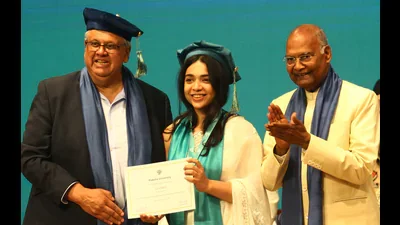
Former President of India Ram Nath Kovind on Saturday urged graduating engineers of Plaksha University to combine technological excellence with compassion and ethics, stating that the highest achievement of any educational institution is not merely producing skilled professionals but “creating good human beings” capable of understanding the pain of others and serving the society.
Event Context
Player Focus
Delivering the special address at the varsity’s second convocation, Kovind said India is going through a defining phase in its development journey, offering unprecedented opportunities to young innovators. He called upon graduates to use their knowledge to solve real-world problems, build startups, undertake cutting-edge research and contribute to nation-building.
“Always have big goals, but never compromise on ethics,” he told the graduating Class of 2026, comprising 90 students across computer science & artificial intelligence (AI), data science, economics & business, robotics & autonomous systems and biological systems engineering.
Highlighting India’s technological rise, Kovind referred to milestones such as the Chandrayaan-3 Moon landing near the lunar south pole, the Mars Orbiter Mission and the country’s growing private space ecosystem. He also cited Indian astronaut Group Captain Shubhanshu Shukla’s journey, recalling a conversation in which the officer told him that Indians were second to none in talent if given the right opportunities.
“True education is not merely about securing employment or accumulating wealth. It is about creating jobs, fostering entrepreneurship and contributing to national development,” he said, adding that India had repeatedly demonstrated its talent and self-reliance.
Former DRDO chairperson Dr Samir V Kamat in his ‘convocation speaker address’ encouraged graduates to embrace ambitious goals and learn from failures as India moves towards technological self-reliance. Plaksha chancellor Prof Shankar Sastry said the graduates were entering an era driven by AI, quantum technologies and embodied intelligence, stressing that future innovators must ensure technology remains safe, ethical and aligned with societal needs.
On the eve of the convocation, Plaksha hosted a panel discussion titled “Building India’s AI Engine”, featuring Sarvam AI co-founder Vivek Raghavan, BharatGen’s Maneesh Singh and Microsoft Research’s Sriram Rajamani. The varsity also inaugurated the Harish and Bina Shah School of AI & Computer Science, established with support from the Harish & Bina Shah Foundation. The new school will focus on AI applications in healthcare, sustainability and ethics, while promoting entrepreneurship and robotics through programmes ranging from BTech to PhD in collaboration with leading global institutions, including Penn Engineering and the University of California, Berkeley.
Team Analysis
Former president’s grandson among graduates
This year’s convocation carried a personal significance for former President Kovind as his grandson, Abhivarya Kumar, graduated from Plaksha University as part of the Class of 2026.
Kovind revealed that he had attended the university’s previous convocation as well because his grandson was then studying at the institution. This year, he said, he returned not just as the chief guest but as a proud grandfather. His grandson was seen respectfully touching both Kovind and Kataria’s feet while receiving the degree on stage.
source
“The sky is never the limit for you,” Kovind told the graduates. “Share your knowledge, your resources and your success with society. That is the true meaning of giving back.”
Focus on strengthening country’s capabilities: Kataria
Addressing the gathering, Punjab governor Gulab Chand Kataria described convocation as a defining milestone in a student’s life, acknowledging the years of hard work by students, the sacrifices made by parents and the guidance provided by faculty members. He urged graduates to channel their education towards strengthening the country’s capabilities through innovation and entrepreneurship rather than pursuing personal success alone.
