
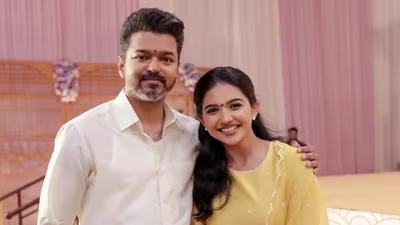
It is rare for Telugu cinema to spark conversations around mental health, child abuse and women’s empowerment. But in 2023, Anil Ravipudi and Bhagavanth Kesari did just that. It did not seem to matter to Nandamuri Balakrishna’s fans that the film was shoddy at best and the conversations performative. So performative that Sreeleela’s character Viji has no agency, because everyone else knows what’s best for her. Does the Tamil remake Jana Nayagan get it right? Do Vijay and Mamitha Baiju’s characters fare any better? *Spoilers ahead*
Event Context
Viji is a young girl who is brought up by Bhagavanth Kesari in the original and Vijay’s Thalapathy Vetri Kondan in the remake. She battles phobias stemmed from watching the death of a loved one at a young age that the film barely manages to scratch the surface of, let alone find a holistic solution for. The only solution boths films offer is to her ‘strong’. Bhagavanth wants Viji to join the army because it’s her dead parents’ dream. He also wants to help her better her mental health, but he never bothers to listen to what she wants or give her any agency.
So, when exactly will the heroes of mainstream cinema take a pause from saving the world, fighting token villains and romancing heroines around half their age, to put the onus on men to do better? To pressure men into contributing to a world where their daughters don’t have to suffer. A world where they’re seen as human beings with agency, not just a responsibility to fulfil, passed off as love. Wanting their child to be financially independent before marriage is probably the only time Bhagavanth and Vetri win brownie points for parenting. Maybe that’s all we get for now.
Jana Nayagan is available to watch in theatres.
Team Analysis
Mamitha Baiju’s Viji doesn’t suffer a fate much different from her Telugu counterpart. The only difference being that this Viji had also expressed interest in joining the army as a toddler. Toddlers are hardly career experts, I’m just saying. At one point, she questions Vetri about why he believes someone timid like her would do well in the army, and he gives the same answer as Bhagavanth: that she needs to be strong enough to survive in a world without him. By the end of the film, not only does Viji join the army, but she also delivers a monologue in defence of her adoptive father. Her phobia is magically cured mid-fight.
One might ask, do parents not push children to do better for their own welfare? Do they not make decisions based on experience? Won’t a father only have his child’s best intentions at heart? That might be well and true, but joining the army and being physically strong is a simplistic solution for a woman who cannot even make her opinion known to her father. Maybe start with some therapy? Or hear her out in the first place.
Probably because Bhagavanth Kesari was lauded for bringing up the topic of child abuse in mainstream Telugu cinema, H Vinoth recreates a scene in Jana Nayagan without giving it any thought. It comes out of nowhere in both films, seemingly placed only so the lead heroes can give a random PSA about a concerning social issue. The problem is that their dialogue places the onus more on the women, and even worse, little children, than on the abusive men.
Match Outlook
Bhagavanth and Vetri encounter a young child who has seemingly been repeatedly abused and, unfortunately, doesn’t realise what’s happening to her. They give a speech addressing young students, teachers, and mothers (fathers, apparently, share no responsibility in this) about ‘good touch bad touch’. Sounds good so far. Then they begin flipping the script and start telling women and girl children they must become ‘tigresses’. Because the implication is that men will be men, even if they’re from your own family.
