
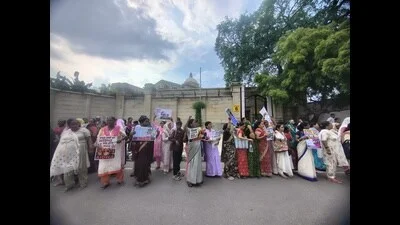
Demanding immediate policy reforms and an end to police heavy-handedness, the All India Democratic Women’s Association (AIDWA) held a seminar on women’s reservation and student issues at its state office near Lok Bhavan on Saturday.
Event Context
Team Analysis
AIDWA national vice president Subhashini Ali in her keynote address said: “The government’s terminology, like ‘Nari Shakti Vandan,’ is mere flattery that falls short of providing concrete rights; the current administration is operating under a patriarchal mindset loyal to the Manusmriti rather than the Constitution,” said Ali.
Calling women’s reservation a standalone right that should have been fulfilled decades ago, she recalled that drafts were prepared as early as 1996 but stalled due to entrenched patriarchy. “Despite receiving unanimous parliamentary approval in 2023, the measure remains unimplemented due to new conditions. Women currently hold only 74 seats in the Lok Sabha, a figure that would jump to 180 under the 33% quota, while state assemblies still register below 10% female representation,” said Ali.
Beyond political rights, Ali drew attention to the severe socio-economic distress facing women, criticising official claims regarding welfare initiatives such as Ujjwala gas cylinders and toilet construction. She argued that soaring inflation has made gas cylinders unaffordable, forcing women back to using smoky traditional chulhas, while sanitation infrastructure remains broken.
Earlier, the session began with AIDWA national vice president Madhu Garg stating, “Two issues are critical in the monsoon session: students’ concerns and women’s reservation. The women’s movement has been demanding 33% reservation in the Lok Sabha and state assemblies for the last 30 years.”
Jyoti from Student Federation of India (SFI) presented a resolution supporting students protesting against paper leaks and education policies at Jantar Mantar in New Delhi. While SFI national vice-president Dipshita Dhar highlighted 152 paper leak instances including NEET over the past decade, linking the crisis to low education budgets, widespread privatisation and rampant youth unemployment.
The delegates also formed a human chain in front of the Assembly to protest against police violence targeting students during the July 20 ‘Chalo Sansad’ march in New Delhi.
Concluding the session, Vandana Rai urged women across the state to assemble in large numbers for upcoming national protests in Delhi to fight for unconditional women’s reservation and to stand shoulder-to-shoulder with student movements. State secretary Seema Katiyar also expressed strong support for the student movements.
