
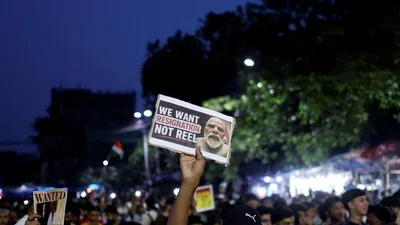
Reacting to the Cockroach Janta Party (CJP) protests now on for about 50 days, the BJP-led NDA government has proposed significantly tightening India’s anti-paper leak law. The proposed legislation seeks to double prison terms for several offences, raise fines up to ₹10 crore, and mandate timelines for investigations and trials.
Latest Update
A newly inserted Section 12A would require investigations to be completed within two months, regardless of whether they are conducted by the police, a central investigating agency or a Special Task Force constituted by the Centre.
The bill also requires every state and Union Territory to designate a Special Fast Track Court to hear offences under the act. The proposed courts would conduct proceedings on a day-to-day basis and, except where adjournments are unavoidable and reasons are recorded in writing, complete trials within three months of the filing of the chargesheet.
Even pending cases would be transferred to these courts and completed within three months of transfer. The amendment further mandates the appointment of Special Public Prosecutors for every such court.
Another significant change is the proposed power for the central government to constitute a Special Task Force to investigate offences under the act. At present, the Centre may transfer investigations to a central investigating agency.
Appeals against judgments, sentences or orders of the Special Fast Track Court would lie before a Division Bench of the High Court and, “as far as possible”, be disposed of within three months of admission. Appeals against bail orders would also be permitted.
Details
While the CJP and the Congress-led Opposition insist on nothing less than the resignation of education minister Dharmendra Pradhan over the NEET-UG paper leaks and other issues, the Centre has sought to counter and assuage the youth movement with this legal framework plan.
Prime Minister Narendra Modi, in a video message earlier this week, had said those who “play with the future of the youth” would face stringent action.
There will also be Special Fast Track Courts and Special Task Forces to deal with organised examination fraud, according to a copy of the Public Examinations (Prevention of Unfair Means) Amendment Bill, 2026, to be introduced in the Lok Sabha on Monday.
If passed, the bill would mark the first major overhaul of the 2024 act. The amendment substantially enhances punishments for individuals, service providers and organised cheating syndicates.
This also means barely two years after Parliament enacted the first law specifically against leaks, the government has acknowledged that leaks continue to undermine confidence in the country’s public examination system despite the enactment of that law.
While the 2024 act primarily created a dedicated legal framework to criminalise organised exam fraud, the amendment focuses on ensuring that investigations and trials are completed within fixed timelines while substantially increasing the penalties.
The Statement of Objects and Reasons accompanying the bill says the Public Examinations (Prevention of Unfair Means) Act, 2024, was enacted to prevent unfair means in public examinations and to “bring greater transparency, fairness and credibility and inspire confidence in the public examinations system”.
However, it adds, “In recent years, there have been some incidents of question paper leakages and malpractices in examinations conducted by public examination authorities, which tend to affect the transparency and fairness of the public examinations system.”
The original anti-paper leak law itself was not enacted as such in response to the 2024 NEET-UG leak row. It became law in February 2024, months before the NEET-UG 2024 examination was held in May and allegations of paper leaks surfaced.
However, the law was technically brought into force only on June 21, 2024, as the government faced mounting criticism over alleged irregularities in NEET-UG and also the cancellation of UGC-NET.
The 2026 bill has a direct link with the NEET-UG leak of this year, as that leak is a major trigger for the ongoing protest at Jantar Mantar by the CJP, a satirical outfit which otherwise took its name from a comment made by the Chief Justice of India in another context.
The bill substantially enhances the penalties prescribed under the 2024 law, with different punishments for different categories of offenders.
Perhaps the most significant shift in the amendment lies in the introduction of strict timelines.
