
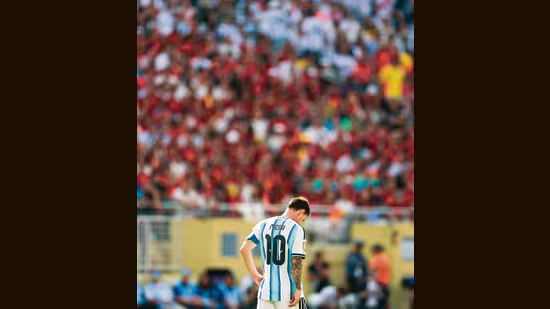
Every football World Cup tells a story.
Event Context
Beyond the winners and almost-winners, the happy surprises and bitter heartbreaks, it tells us a little more about the world we inhabit, and reveals new facets of the one sport that enrages and enthuses us more than any other.
The first three World Cups (1930, ’34 and ’38), held amid the Great Depression and with Europe hurtling towards World War 2, established the domination of Italy’s 2-3-2-3 method, opening the door to tactical formations.
The 1950s and ’60s marked the rise of the Samba beat, as Brazil’s free-flowing style provided joy and optimism in an era of post-war buoyancy.
The ’70s,’80s and ’90s, in a world divided by the Cold War, split football into two overarching styles: South American ingenuity and European solidity.
So, if the 2018 World Cup was about France’s superstars ruling from on high, and 2022 about Lionel Messi fighting to claim his crown at long last, what did the 2026 World Cup teach us about life and football? Here are three takeaways.
WOLF IN GOAT’S CLOTHING
To put his age in perspective, Pele was 29 in his last World Cup in 1970, and Maradona and Zinedine Zidane were 34 in the 1994 and 2006 tournaments respectively.
From his opening strike in the 17th minute of the group match against Algeria to his 92th- minute assist to Lautaro Martinez in the semi-final against England, Messi soared above everyone else on the pitch. He would be ambling listlessly for large portions of the game, conserving energy, but constantly getting himself into positions from where he could unleash turbocharged mayhem when obe least expected.
Messi’s dance was a tango where lingering cat-like arches morphed into lightning-fast flicks and turns. He may not have finished it the way he wanted to in the final against Spain (we’ll get to that in a bit), but he proved one last time that he could go toe to toe with players born after he’d made his World Cup debut 20 years ago, hogging the headlines amid wars and protests.
THE SYSTEM (ALMOST) ALWAYS WINS
The Spanish football team, which proved to be Messi’s nemesis in the end, arrived at the World Cup as reigning Euro champions. They came with a reputation of being able to move the ball around as deftly as the legendary 2010 Spain team that won the World Cup — with one critical difference: hardly any member of the current squad would have made it into the galaxy of stars from 16 years ago.
That’s why the pundits did not favour Spain as heavily as they did France, Argentina, England and Brazil, at the start of the tournament.
What they overlooked was that the Spanish football system is so robust, and so central to how the team plays, that the personnel don’t matter as much. This first became apparent in the 1-0 last-16 win against Portugal, when Spain kept knocking at the door before finding a winner in the 90th minute. Then in the semi-final against France, where the odds-on favourites were run off the pitch with a masterclass in ball movement, exemplified by Pedro Porro’s brilliant 1-2 with Dani Olmo for the second goal.
This beauty was in sharp contrast to the brutishness of the Argentina players after losing a final they did not deserve to win, and the cries on social media about favouritism by the Video Assistant Referee (VAR) in the last two weeks of the tournament.
Player Focus
Over the next two decades, after Communism had fallen and the frailties of Capitalism had been exposed, superior TV coverage, breathless social-media rants and new technological interventions made football less forgiving, the players fitter, and the opinions more divided than ever before.
Last Sunday, with the shadow of Manhattan looming in the distance and US President Donald Trump sitting in attendance, Messi stepped into position for the final pirouette of his last dance. A dance that seemed both unlikely and unnecessary for a 39-year-old. A dance that we thought he had already danced in Qatar four years ago, when the greatest club player of all time ensconced himself as the greatest with no caveats.
The midfield of Rodri, Fabian Ruiz and Dani Olmo was impressive, but not exactly in the same league as Xavi, Iniesta, Busquets and Xabi Alonso. The forwards Lamine Yamal, Alex Baena and Mikel Oyarzabal were a step behind the David Villa and Fernando Torres partnership, the defenders Pedro Porro, Pau Cubarsi, Aymeric Laporte and Marc Cucurella could not compare with Sergio Ramos, Carlos Puyol, Gerard Pique and Joan Capdevila. Even goalkeeper Unai Simon and his backup David Raya were no Iker Casillas.
In the final, the Spanish system did not give Argentina, or even Messi, a look in. In fact, it neutralised him in a way no other team had managed to do, reducing him to zero shots on target in 90 minutes and just one in extra time. The final score may have been 1-0, but it felt more like 4-0.
Spain’s run showed that, in football, philosophy almost always trumps chaos. And though it may look boring when compared with a midfielder dribbling past three players, the system, too, can be a beautiful thing.
VAR NEEDS TO BE BOOTED, OR AT LEAST REBOOTED
For those of us who watch league football through the year and have been battling the vagaries of VAR, its inconsistency is not a new thing. But the millions who tune into the sport once in four years found some of the calls appalling. In a world where reel and real overlap more than ever before, disgruntlement sparks conspiracy theories. And so the theory emerged that Argentina were being given an unfair advantage by a corrupt administration to ensure Messi got a perfect send-off.
The real problem here is not some giant plot involving referees from all over the world, but that VAR is broken and needs to be fixed. It tries to examine a subjective call by taking a second subjective call. That’s not how replays should be used. Instead, VAR should only make objective calls to overrule clear and obvious errors, as the decision review system (DRS) does in cricket. There, Hot Spot and Snicko tell you if the ball was edged, the tram lines of Hawk-Eye tell you if it was an LBW. Good tech or bad, these are objective yardsticks that are easy to follow and can be applied uniformly.
Team Analysis
There were long stretches when he and his team seemed ineffective. But a crossover here, a nutmeg there, and the ball would be in the back of the net.
So, the big takeaway: Use VAR only for offside calls — it’s the one bit of objective tech available at this time — until you can develop tools that offer uncomplicated guidelines for other decisions. And remember the golden rule: Don’t attribute to malice that which can be adequately explained by incompetence.
(The views expressed are personal)
Match Outlook
Once we knew he would play, the world expected a different kind of Messi to show up. One who would be the talisman of the team, rather than grab matches by the scruff of the neck; one who would be subbed off early or brought on late, rather than play 90 or 120 minutes in every game; one who would take control in the big moments, rather than dictate the flow of matches.
