
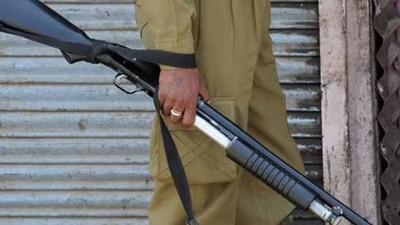
The allegations of the use of “pellet guns” – pump-action shotguns that fire cartridges containing hundreds of tiny metal or rubber balls – during Monday’s crackdown on protesters in Delhi has once again brought under scrutiny the controversial weapon which was first used in the country by the Central Reserve Police Force (CRPF) during stone-pelting incidents in 2009-10 in Jammu and Kashmir (J&K)
Event Context
While the Delhi Police has denied deploying or using them, CRPF officials refused comment on their use in the Capital.
Security officials and former officers said these so-called pellet guns are modified pump-action shotguns that fire a cartridge packed with hundreds of small metallic pellets. When discharged, the cartridge bursts open, scattering the pellets across a wide area.
Designed as a “non- or less-lethal” alternative to conventional firearms, the weapons are intended for crowd control but have repeatedly drawn criticism because they can cause serious injuries, particularly to the eyes and face.
Track live updates of CJP protest here
If the allegations surrounding Monday’s protest are confirmed, it would mark the first known use of pellet guns during crowd control in Delhi. During the 2021 farmers’ protests, security forces instead relied on rubber bullets, tear gas and water cannons to prevent protesters from entering the Capital.
A security officer, requesting anonymity, explained: “The pellets can cause injuries if fired from around 20 to 30 metres. Beyond that, their effectiveness drops significantly. They are intended to disperse violent crowds rather than target individuals, but if fired from very close range, or if pellets strike the eyes or other vulnerable areas, they can cause serious injuries.”
Retired CRPF inspector general Vikram Sahgal described the weapon as part of the standard inventory available to specialised riot-control units. “A pellet gun falls under the category of less-lethal weapons. It is intended to be used only after measures such as tear smoke or other crowd-control techniques have failed. When used under proper supervision and with due precautions, it is designed to minimise the risk of fatal injuries, though it must always be employed with restraint,” Sahgal said. “Whether they have actually been used or authorised for use in the recent past is beyond my purview and knowledge, as I am no longer in service.”
Also read: Jantar Mantar protest: Medical reports show injuries, but CRPF, police silent on ‘pellet gun’ use
Officials familiar with crowd-control protocols said pellet guns are generally available with RAF units rather than Delhi Police, which does not maintain pump-action pellet guns in its own inventory. Any decision to escalate force during a law-and-order situation is taken jointly by the police commander on the ground and the senior CRPF officer present.
“In states, a district magistrate generally authorises the use of force such as lathicharge or non-lethal weapons. In Delhi’s commissionerate system, that power rests with the deputy commissioner of police, who decides the level of force required after assessing the situation with the CRPF commander,” one official explained.
Former Delhi Police commissioner SN Shrivastava, who also served as special director general of CRPF in Jammu and Kashmir, said he was sceptical that pellet guns had actually been used in Delhi. “When a pump-action gun is fired, the pellets disperse over a wide area. If they had been used, there would likely have been multiple people suffering pellet injuries simultaneously. Based on the information available publicly, I am not convinced pellet guns were deployed,” Shrivastava said.
The same category of pump-action weapons is also used by the Border Security Force (BSF) along the India-Bangladesh border as a non-lethal alternative to conventional firearms against smugglers and illegal border crossers, reflecting their continued use by central armed police forces in situations where security personnel seek to avoid lethal force.
Player Focus
HR Singh, former CRPF additional director general, said the weapon was developed by the Defence Research and Development Organisation (DRDO) and first used during the wave of violent stone-pelting incidents in Jammu and Kashmir in 2009-10. “It was developed in response to situations where violent crowds were pelting stones or throwing chilli powder at security personnel. DRDO also developed other crowd-control equipment such as smoke grenades. Pellet guns are generally part of the inventory of the Rapid Action Force (RAF), though they can also be used by other CRPF personnel deployed for riot control,” Singh explained.
Their use expanded significantly in 2016, after the killing of Hizbul Mujahideen commander Burhan Wani triggered months of violent protests across the Valley. Hundreds of civilians sustained eye injuries during that period, leading to widespread criticism from human rights groups and medical experts.
Also read: Decoding police powers, rights of protesters and law on use of force
Team Analysis
To be sure, Delhi Police has maintained that it did not deploy pellet guns. CRPF, whose RAF companies have been deployed alongside Delhi Police since the protests began, has not commented on the allegation.
