
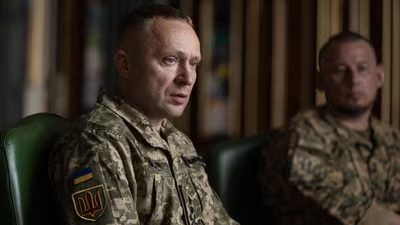
RENOWNED GENERALS from George Patton, who strutted about in cavalry boots and carried two ivory-handled pistols, to the ascetic Bernard Montgomery, all understood that the morale of their troops depends a lot on the image they project of themselves. Few will have taken the job with the legendary status of Mykhailo Drapaty, who was named as the commander-in-chief of Ukraine’s armed forces on July 21st, replacing Oleksandr Syrsky.
Event Context
General Drapaty, aged 43, first rose to fame as a young major in 2014 when Russia-backed separatists tried to seize Mariupol, a city on the south-east coast. Leading from the front in command of a column of four armoured vehicles, he smashed through rebel barricades and into the city. Later that year he led his battalion on a raid along the Russian border to cut off separatist fighters. His force, along with others, came under fire from Russian troops and was encircled. When a sister battalion surrendered, he led some 260 troops back to Ukrainian lines.
He was later deployed to a role in which he was more directly involved in planning combat operations, where he won the praise of his subordinate brigade commanders for listening to them and offering support, noted Rob Lee, an expert on the Ukraine war: “He is a critic of Soviet-style thinking and micromanagement.”
Team Analysis
This approach was in stark contrast to that of General Syrsky, who was sacked by Volodymyr Zelensky, Ukraine’s president, amid big protests calling for him to go. General Syrsky had been unfairly nicknamed “the butcher of Bakhmut” because of the losses suffered during his dogged defence of the city in 2023. Many commentators present the contrast between Generals Drapaty and Syrsky as a generational struggle between a young tech-savvy drone enthusiast and a Soviet-style traditionalist. But that misses the main points of difference between the two.
General Syrsky also developed a reputation for micromanagement and a refusal to fully accept the authority of the defence minister, Mykhailo Fedorov, another young moderniser. When Mr Fedorov tried to consolidate weak and poorly led units, General Syrsky formed new brigades, diluting already-scarce manpower. “Syrsky took several of Ukraine’s best units and deployed them as a split formation across opposite ends of the front,” wrote Jack Watling of the Royal United Services Institute, a think-tank in London.
After clashing with General Syrsky and failing to oust him, Mr Fedorov was sacked on July 15th by Mr Zelensky. The move triggered the protests calling for General Syrsky to go—and for Mr Fedorov’s return. Mr Zelensky has reportedly offered Mr Federov a new job, though it is unclear whether he will take it: the spat has damaged his trust in Mr Zelensky. The outcry over Mr Federov’s sacking and its chaotic aftermath have badly damaged the president’s authority. The demonstrations included wounded soldiers such as Andriy Syry, aged 27, who lost his foot to a drone strike last year. He attached a banner to his crutch reading: “I can’t stand up but I won’t shut up.” Whatever the talents of the new commander-in-chief, the problems facing him have no easy fix.
source
General Syrsky oversaw the widespread adoption of drones in the Ukrainian armed forces and the strategy of using medium-range drones to isolate Crimea and long-range drones to hit oil installations deep in Russia. Yet he also saw the value of investing resources in more traditional kit, such as tanks and artillery, since these are needed to blunt and break up attacks that would overwhelm defenders armed only with drones.
He is also seen as a talented tactical commander, who skilfully led the defence of Kyiv in 2022 and an offensive into Russian territory near Kursk two years later. The bigger concerns about General Syrsky’s leadership relate to what some saw as strategic blunders as well favouritism in the allocation of reinforcements and other resources. Western officers involved in the planning of Ukraine’s big summer offensive in 2023 accused him of diverting troops to Bakhmut instead of concentrating forces for an attack in the south. Allies of the general counter that he was tying down Russian troops and that, if there was any misallocation of forces, blame for that should fall on Valery Zaluzhny, who was the chief commander at the time.
