
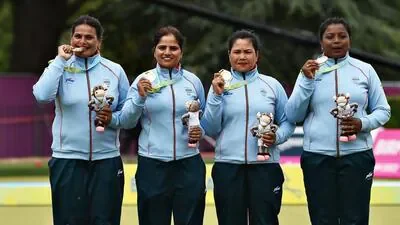
Mumbai: Pinki felt the pressure from within.
Event Context
The trials to select India’s lawn bowls squad for the Glasgow Commonwealth Games (CWG) were taking place at the Delhi Public School, RK Puram, where she is a physical education teacher. As a CWG gold medallist at Birmingham 2022, she wanted to live up to her reputation in front of her students, colleagues and principal.
“No one would have said anything, but this was my school. If I wasn’t selected, what would my image be?” Pinki said.
Navneet Singh’s pressure came from elsewhere. During a conversation with a federation official, he was reminded of what they did the last time. Which was bring home two medals – women’s fours gold and men’s fours silver – from the 2022 CWG. “I was told, ‘this time too, you have to win medals’,” Navneet said with a smile.
India’s lawn bowls players are not used to this. For years, they competed in relative anonymity, often travelling to tournaments at their own expense and winning medals that barely registered back home.
Until the Birmingham breakthrough changed things, even if not drastically.
Today, lawn bowls at least rings a bell. Its players carry a measure of recognition and in April, the Bowling Federation of India finally received the sports ministry’s recognition.
“We are not used to playing indoors, or this format,” said Navneet. “But in 2022, we played no tournaments before going there. This time, we did really well at the Asian Championships (held in Delhi in April). So that’s a good thing.”
Good things have happened to the sport in India since the 2022 CWG, but not at the level Navneet would have hoped. Although improved, recognition and reward, he felt, are far from ideal (for his Asian and national medals, the Delhi athlete said he got around ₹1.5 lakh cash award in total).
Navneet is a commercial pilot now, earning his licence last year. Despite surviving on little sleep during his training, he never gave up on lawn bowls. His average weekly schedule comprises three days of flying and three days of hitting the greens. Strength training is reserved for hotel stays or layovers.
“There’s a reason why I’m working and flying day and night. I have to financially support my family, which my sport isn’t able to fully. I’ve thought about this a lot. But my love for lawn bowls and doing something for the country keeps me going,” he said.
Team Analysis
India heads to the 2026 Glasgow CWG not as outsiders, but as medal winners in lawn bowls.
The event in which India won those historic medals has been struck off, and this contingent is smaller. Only three women and men each were selected, and five will carry the memories of Birmingham – Pinki, Rupa Rani Tirkey, Nayanmoni Saikia, Navneet and Dinesh Kumar – alongside debutant Putul Sonowal.
Glasgow, however, will present a completely different challenge.
“Teams competing in nationals have risen from 8-9 to 18-19 now. I get coaching requests on my Instagram DMs. My father now gets recognised because of me,” said Pinki.
“Amongst the sports fraternity, even in events organised by the ministry or IOA, there is greater awareness,” said Navneet. “And the people who closely follow Olympics and CWG sports, they now know about lawn bowls.”
Four years after their medal breakthrough, these pathbreakers carry a different kind of pressure.
“Last time, the pressure was that nobody knew your sport, so if you didn’t win medals, no one will care,” said Navneet. “This time, the pressure is about doing what we did, once again.”
Match Outlook
Four years ago, few followed what unfolded on the outskirts of Birmingham, where two medals from India’s tally of 61 became the contingent’s most unexpected story. Few saw it coming. Fewer knew the faces behind it – or even the sport.
“People now have expectations from us,” said Pinki. “The 2022 medals have given people those expectations. We have to live up to them.”
Those expectations are amplified by the smaller scale of this year’s Commonwealth Games. With a big chunk of India’s medal-earning sports excluded at Glasgow, lawn bowls remains only one of five able-bodied sports from 2022 in which India had medalled. The truncated Games have also taken away a share from lawn bowls’ pie. From four events for each gender at Birmingham, 2026 features just two (singles and pairs).
For the first time in CWG, lawn bowls will be held indoors, and on synthetic carpet as opposed to natural grass. The format too is shorter and quicker (singles will comprise two sets of seven ends, with one end tiebreaker if needed. Pairs will be two sets of five ends, with a tiebreaker).
“It’s like going from ODIs to T20s,” chuckled Pinki, a former cricketer. “We have largely played on grass. The speed on that surface, I hear, will be a lot faster.”
The squad has been in the UK since early July, and reached Glasgow on Monday.
For Pinki, it is the hunger to compete. This will be her fifth CWG, starting with Delhi 2010. At 45, staying competitive requires greater attention to fitness. She chooses working on that over even family holidays. “If I have to compete with youngsters, I have to be fit enough to fight with them at the CWG,” Pinki said.
She has had first-hand experience of the mindset shift in Indian lawn bowls, where competitors have gone from mere participants to serious believers.
“Through the years after 2010, I told myself, ‘Look, now I’ve understood the game and I’m able to play at a certain level too. So, what is missing?’ The belief gradually came with a lot of work and experience.”
That belief has surged. So has the spotlight on the sport.
