
In his office in downtown Beirut, Amer Bisat looks to the past to sketch a hopeful vision of the future. Lebanon was once the region’s premier entrepôt, a hub for banking, tourism and trade; perhaps it can be so again. “If reconstruction ever starts in Syria, for example, Lebanese ports might be part of that,” says the economy minister. He also hopes to woo Gulf states keen to lay pipelines and fibre-optic cables that bypass the Strait of Hormuz. “The region is being redrawn in many ways,” says Mr Bisat, “and Lebanon has a huge role to play.”
Event Context
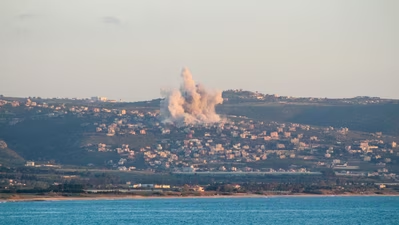
When Mr Aoun visits the White House on July 21st, the first Lebanese president to do so since 2009, much of his conversation with Donald Trump will probably focus on Hizbullah. The militia dragged Lebanon into war on October 8th 2023, when it fired rockets at Israel in support of Hamas, the Palestinian militant group that had just massacred around 1,200 people. Though America imposed a ceasefire in November 2024, Israel continued regular air strikes in Lebanon (Hizbullah was too degraded to retaliate). All-out war resumed in March this year, when the militia attacked Israel on Iran’s behalf.
The cost has been enormous. The government estimates that the most recent fighting caused $3bn-4bn in direct damage, on top of $8.5bn from the previous round (around 40% of gdp in total). It will also lop 7-8% off Lebanon’s output this year; Mr Bisat expects a recession.
Israel has razed villages in the south and occupied a swathe of the region. Hizbullah’s death toll is heavy. In eastern Lebanon’s Bekaa Valley, your correspondent counted a dozen posters announcing the deaths of Hizbullah fighters in one Shia village, home to perhaps 1,500 people. That is only a partial accounting: the group has yet to recover and identify all of its dead, and some families have been told not to mourn publicly. It is plausible, then, that 1-2% of the village has been killed fighting Israel since 2023. In the south, black-clad women spend their days visiting one home after another to pay condolences.
Second is how to ensure Israeli withdrawal: the state will not look credible unless it does. The deal with Israel is meant to start with two “pilot zones” (see map), a proof of concept that will show the Lebanese army can move in and Israeli troops can pull out. Officials in Beirut complain that one of these zones includes villages that Israel never occupied in the first place. Meanwhile, it continues periodic air strikes in the south. The lawnmower buzz of an Israeli surveillance drone is ever-present background noise in much of Lebanon, even at the hilltop presidential palace in Baabda.
The final question is who will pay to rebuild. The last time Lebanon’s friends organised a donor conference, in 2018, they pledged $11bn but never disbursed the money because the government failed to implement required reforms. America no longer believes in foreign aid. When Mr Aoun visits the White House, he does not plan to ask for any. Bureaucrats have prepared glossy presentations on how American firms might benefit from investing in ports, telecommunications and other infrastructure. Yet the same concerns that put off donors before may spook would-be investors today.
Lebanon’s crises overlap. The financial crash was decades in the making—the result of a state-run Ponzi scheme meant to finance massive deficits and keep the currency pegged at 1,500 to the dollar. When bank deposits flattened off in 2019, the scheme collapsed. Lenders in effect halted foreign-currency withdrawals. The following years were marked by hyperinflation, rapid depreciation and political paralysis. Though Lebanon reached a tentative four-year, $3bn deal with the IMF in April 2022, the fund’s board never put it to a final vote. Again, lack of reform was the issue: the banks have powerful allies in parliament, who blocked any attempt at restructuring.
If things look better now, it is only because they were so bad before. The currency has settled at just shy of 90,000 to the dollar, 98% below the peg. Annual inflation has cooled from a peak of 221% in 2023 to 15% last year, still among the highest in the world. At $30bn, the economy is about half its pre-crisis size (it was $55bn in 2018). Depositors are still mostly locked out of their accounts, able to withdraw $800 or less per month.
Mr Salam’s government has taken some meaningful steps. In April 2025 it eased the bank-secrecy law, a longtime IMF demand. Three months later it passed another bill that lets the state restructure or liquidate insolvent lenders. But it has yet to approve the most consequential (and controversial) piece of legislation: the so-called “gap law”, which would apportion roughly $80bn in losses between banks, depositors and the state.
Team Analysis
As Joseph Aoun, Lebanon’s president, travels to Washington on July 21st to meet Donald Trump and encourage American investment, it also stands as a warning to would-be investors—one of many in Lebanon today. The period since mass anti-government protests in 2019 has been the worst for the country since the end of its long civil war in 1990. It has endured the port explosion, a financial crisis and almost three years of war with Israel.
For most of this time it muddled through with a series of caretaker prime ministers and, for more than two years, no president. The vacuum ended in January 2025, when parliament selected Mr Aoun. Days later Nawaf Salam was named prime minister. They make an odd couple. Mr Aoun, bald and broad, is a career soldier, while the bespectacled, bookish Mr Salam is an academic and diplomat who spent much of his life abroad.
Both are political outsiders in a country long dominated by a crop of ex-warlords. In their inaugural speeches they pledged to disarm Hizbullah, the Iran-backed Shia militia that has long defied the government’s authority, and to implement long-overdue reforms. The watchword for both was sovereignty: no longer would Lebanon be defined by foreign meddling and state weakness.
Eighteen months on, their record is mixed. They have taken some laudable decisions, from proscribing Hizbullah’s military wing to passing laws that should help unlock an IMF deal. Implementing decisions is another matter, and the forces of inertia are strong. Lebanon’s twin crises have become a Gordian knot. It will struggle to attract donors and investors unless it defangs Hizbullah, yet its strategy for doing so relies on those same donors and investors. Untangling the knot will mean doing everything at once—disarmament, reform and reconstruction—in a country that has long struggled to do anything at all.
But the army is in no state to force the issue. Hizbullah is still better equipped. Though defence spending has more than tripled since 2021, most of the budget goes to wages, not weapons. Some officers are thought to be sympathetic to Hizbullah. Nor are courts much of a deterrent. One illegal-weapons case in March ended with Hizbullah members being fined just 900,000 Lebanese lira ($10).
Match Outlook
For decades Hizbullah has been a state within a state. It runs an extensive welfare network of schools, hospitals and youth programmes; it even operates a parallel banking system, which helped shield its supporters from the financial crash. These activities bred a loyalty that the state itself could not match—but the latest war has strained it. The group cannot afford to rebuild ruined areas. Its bank, al-Qard al-Hassan, has faced cash shortages.
Many of its constituents are exhausted. Some are concerned by Iran’s growing sway over the group. In March the Lebanese government tried to expel the Iranian ambassador, accusing him of using his post to support Hizbullah on behalf of the Islamic Revolutionary Guard Corps (irgc), the Iranian regime’s praetorians. He refused to leave. In June Mohammad Bagher Ghalibaf, the speaker of Iran’s parliament, praised Lebanon for offering 4,000 “martyrs” in support of his country. His comments outraged many Lebanese.
Officials close to Mr Aoun thus see an opportunity to flip the script. “We hope to have two clear scenes,” says one: “Hizbullah killing your sons for the Iranian interest… and on the other hand, we have a Lebanese state keen to protect them, to reconstruct their villages and homes.” It is a creative approach, more carrot than stick. But it faces three big obstacles.
First, and most difficult, is how to disarm Hizbullah. That looks like an insurmountable challenge. The group refuses to comply and is fond of threatening a new civil war if anyone tries to take its weapons. Nonetheless, last August the cabinet agreed on a plan to gradually do just that, and in March it declared the group’s military wing illegal. Several dozen people have since been arrested for transporting arms. In June Israel and Lebanon signed a deal that commits the latter to deploy its army in southern Lebanon.
Little money exists to fix any of this. The government ran a fiscal surplus of 2% of gdp last year, and despite the war it expects to post a narrower one in 2026. Yet more than half of revenue is spent on wages and pensions. Fouad Makhzoumi, an mp and aspiring prime minister, estimates there are 340,000 people in the public sector, almost 10% of Lebanon’s citizen population. “We asked the government to tell us how many employees we have,” he says. “Until now, we have no idea.”
Ministers take care to distinguish between themselves and “the system”. It seems an odd distinction: surely the cabinet is at the centre of a parliamentary system. But it is an accurate one. Hizbullah still controls the guns. Bankers and their allies can still block a financial overhaul, and confessional chieftains parcel out the spoils of the state. The system is built to outlast would-be reformers.
Sovereignty is not just about the Israeli drone whirring overhead or the Iranian ambassador who refuses to leave. It is also about freeing the state from an establishment that feeds on its weakness. “This is a system that has ways of saving itself, and that should not be underestimated,” says one elder statesman. For now, the ruined silo by the port seems like a symbol for Lebanon itself: neither fallen nor rebuilt but caught mid-collapse.
Sign up to the Middle East Dispatch, a weekly newsletter that keeps you in the loop on a fascinating, complex and consequential part of the world.
source
Under a draft proposal approved by the cabinet in December, small depositors would be able to recover up to $100,000 over four years. Mr Salam says that will cover 85% of account-holders. The rest will receive asset-backed securities that may take as long as 20 years to pay out. This plan is unworkable, however. Payments to depositors would cost at least $22bn over four years, far more than the state or the Banque du Liban, the central bank, can afford. Three sources say the four-year timeline will have to be extended.
Fixing the banks is only a first step. Lebanon also needs new sources of growth. Mr Bisat points to start-ups that are making hardware for robotics and AI data centres. With its strong universities, cheap labour and entrepreneurial culture, Lebanon has some comparative advantages. “There are certain services that we excel at…things like high-level tourism, high-level design, construction services, consultancies,” he says.
For all its talented businesspeople, though, Lebanon has a terrible business climate. The war is one problem. Zombie banks are another: the economy has lost its financial infrastructure. Lending has collapsed. Credit to the private sector has plunged from 107% of gdp in 2018 to less than 20% today.
Lebanon’s infrastructure is in a parlous state. The state-run electric company can supply only a few hours of power per day. Businesses pay for a private generator subscription—which, at $0.48 per kilowatt-hour, is nearly three times pricier than the global average. Expensive deliveries of water from private lorries supplement erratic public utilities. Firms, lumbered with slower broadband speeds than in Somalia, are desperate for Starlink to launch so they can ditch the lousy state-run telecoms monopoly.
