
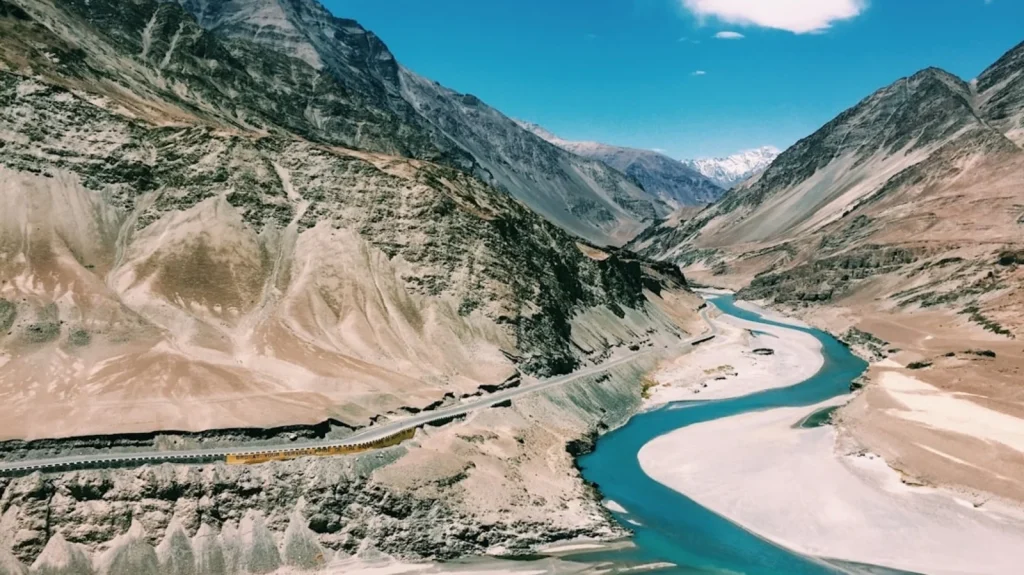
Pakistan today faces an unusual historical dilemma. A state created in 1947 on the foundations of Muslim political identity is increasingly presenting itself as the custodian of a civilisation that flourished thousands of years before the advent of Islam in South Asia. Harappa, Mohenjo-Daro, Taxila and Gandhara have moved beyond being archaeological sites of historical importance and have become symbols of Pakistan’s national identity, cultural diplomacy and international image-building. Pakistan increasingly presents itself as the inheritor of one of the world’s oldest urban civilisations, the Indus Valley Civilization (IVC), which flourished more than 5,000 years ago.
Event Context
The renewed focus on the Indus civilisation has emerged at a time when the Indus river system has become increasingly significant in India-Pakistan relations. The Indus Waters Treaty, signed in 1960 with World Bank mediation, has long governed the sharing of the Indus river system between the two countries.
Following India’s decision in 2025 to place the treaty in abeyance after the dastardly Pahalgam terror attack, the Indus became not only a technical water-sharing issue but also a geopolitical symbol. By highlighting its connection to the Indus civilization, Pakistan adds a historical and emotional dimension to its argument over a river system that predates modern political borders.
It is another matter that the Indus Water Treaty has in fact been negotiated in favour of Pakistan as nearly 80 percent of water of the western rivers goes to the Islamic Republic while only 20 per cent is for usage in India.
The Narendra Modi government put the IWT into abeyance to put pressure on Pakistan on dismantling the terror factories in that country as the Indian PM after Pahalgam made it clear that water and blood cannot flow together.
Even though Pakistan has been playing the victim card globally over IWT, fact is that India has not stopped even a cusec of water as dams and canal building are still work in progress. The only thing that has happened is that India has stopped sharing data of western river flows to Islamabad. Given the snail speed at which the Indian bureaucracy works, Pakistan will not face any ramifications at least in the coming couple of years.
But the Pakistan politician is already trying to score brownie points with the west and at the same time threatening to bomb Indian run of the river dams on the western rivers.
The Indus Valley narrative also suits Rawalpindi rulers as it unites restive provinces like Sindh, Khyber-Pakhtunkhwa as basin states of the mighty Indian river system.
The unity narrative message under the Indus Civilization brand comes at a time when entire Pakistan is up in flame including Occupied Kashmir, Gilgit-Baltistan, Balochistan, Khyber-Pakhtunkhwa and there is serious military tension on the Durand Line with the ruling Taliban giving a befitting reply to Islamabad.
Going back to its pre-Islamic history is not only limited to Pakistan but also countries like Iran, Egypt and Iraq as the younger generation wants to know its past and not be held prisoner by radical Islamists and Mullahs. So while Pakistan and its western supporters want to rake up Indus Civilization, Iran suddenly remembers its Persian past, Egypt remembers its Pharaohs and Iraq its Mesopotamian past.
But the unscrupulous state that Pakistan is, it has revived the Indus Civilization narrative after claiming the lineage of Turks after having close ties with Turkey and Arabs after close ties with Saudi Arabia. Bottomline for this chameleon nation is opportunity and shared hatred of India with Hindus being specially targeted by Asim Munir and his toxic ideology.
Another 2025 study, Inclusive Education for a United and Harmonious Pakistan, analysing Punjab textbooks, identified gaps in inclusivity, underrepresentation of minority communities and the need for reforms promoting tolerance and critical thinking. These findings echo earlier concerns raised by the United States Commission on International Religious Freedom (USCIRF), which documented instances where public school textbooks reinforced negative stereotypes regarding non-Muslim communities.
Against this background, Pakistan’s renewed celebration of Harappa, Mohenjo-Daro, Taxila and Gandhara represents a notable adjustment. The question is not why Pakistan should celebrate these sites. The question is why the same sites are now being elevated within a national narrative that historically placed greater emphasis on Islamic origins.
The most difficult question for Pakistan’s civilizational narrative concerns contemporary pluralism. International organisations have repeatedly raised concerns regarding religious freedom in Pakistan. International organisations including: the United Nations Special Rapporteurs; Amnesty International; Human Rights Watch and the United States Commission on International Religious Freedom (USCIRF) have repeatedly documented concerns regarding: misuse of blasphemy laws, mob violence, discrimination against religious minorities, restrictions faced by Ahmadis who were constitutionally declared non-Muslims through the Second Amendment in 1974.
The contrast remains visible. Pakistan seeks recognition as the inheritor of an ancient civilisation associated with urban planning, trade, intellectual exchange and cultural diversity, while continuing to face international criticism regarding the protection of religious minorities within the modern state.
Pakistan’s renewed embrace of the Indus Valley Civilization represents not only a cultural revival but also a broader attempt to reshape its historical image through heritage diplomacy. However, the selective emphasis on pre-Islamic heritage raises questions about its compatibility with the ideological foundations of the modern Pakistani state, which has repeatedly defined its identity through the Two-Nation Theory, Islamic values and a distinct Muslim political narrative. The contradiction becomes more evident when this cultural pluralism is examined against contemporary realities.
If Pakistan’s engagement with history reflects a genuine commitment to diversity and civilisational continuity, then the same principles should extend to the treatment of religious minorities within the country. A civilisational identity cannot be limited to archaeological sites and international cultural campaigns; it is also measured by how a state protects the rights, heritage and dignity of communities living within its borders. And in that aspect, Pakistan and its anti-India political-military leadership has failed miserably.
Player Focus
Pakistan’s founding narrative was not built around ancient civilisation. It emerged from the argument that Muslims of South Asia represented a separate nation. The ideological foundation of Pakistan’s state identity was institutionalised through constitutional developments that placed Islam at the centre of governance.
The Objectives Resolution of 1949 declared that “sovereignty over the entire universe belongs to Almighty Allah alone,” establishing a framework linking state authority with Islamic principles. This direction was reinforced by the Constitution of 1956, which declared Pakistan an Islamic Republic, and further strengthened by the 1973 Constitution, which made Islam the state religion and required laws to conform with Islamic principles. In 1985, Islamist dictator General Zia-ul-Haq’s government incorporated the Objectives Resolution into the Constitution as Article 2A, giving it constitutional authority.
These developments cemented Islamic identity as a core element of the Pakistani state.
This ideological framework continues to influence Pakistan’s official discourse. In April 2025, then Pak Army Chief General Asim Munir repeatedly invoked the Two-Nation Theory in public addresses. While speaking to overseas Pakistanis after Pahalgam attack, Munir stated that Muslims and Hindus were distinct communities with differences in religion, traditions and social values, describing this distinction as the basis of the Two-Nation Theory.
At the Pakistan Military Academy, he again emphasised that Pakistan’s creation was rooted in a separate Muslim identity. The significance of these remarks lies not only in the words themselves but also in who delivered them.
Pakistan’s military has historically played a central role in defining questions of national identity, security priorities and ideological boundaries. The message remains consistent: Pakistan was created as a state based on Muslim political identity.
Team Analysis
Pakistan’s historical emphasis has evolved considerably since its creation. For much of the country’s history, official narratives gave greater importance to Islamic political history. Pakistan Studies textbooks traditionally focused on Muslim rulers, the arrival of Islam in Sindh in 712 CE, the Mughal period and the Muslim League movement.
Scholars such as KK Aziz, in his influential work ‘The Murder of History: A Critique of History Textbooks Used in Pakistan’, criticised Pakistan’s education system for selectively presenting history through ideological priorities. During the era of General Zia-ul-Haq, educational policies placed even greater emphasis on Islamic identity and ideological themes.
Even today, Pakistan’s educational curriculum continues to place significant emphasis on the country’s identity as an Islamic Republic, while questions remain regarding the representation of religious minorities and pluralistic interpretations of history.
A 2025 study published in the British Journal of Religious Education examining Pakistan’s National Curriculum textbooks found that educational materials contribute to the construction of religious identity and the portrayal of the “religious other”, raising concerns about the limited space provided for inclusive narratives.
Match Outlook
Pakistan is obviously helped in the Indus Civilization narrative by legatee western powers who think that they still run the Indian sub-continent. There are some within India who are playing the China card to remind the Modi government that Indus and its major tributaries rise in Tibet and are in control of Pakistan’s iron brother Xi Jinping. A deliberate attempt is being made to instil fear within India that China could do the same to India in the eastern and western sector, what New Delhi is presumably doing to Islamabad. All India is asking Pakistan is to stop targeting innocents across the borders using terror as an instrument of state policy.
Since Zia-ul-Haq weaponized Islam to achieve political power in Pakistan and against India, several thousand innocents have lost their lives in Kashmir, Punjab and in hinterland to terror strikes, IED-bomb attacks and indiscriminate firing by area weapons.
While the pusillanimous Indian governments in the past did not retaliate, the present Modi government has openly declared that terrorism is an act of war. The IWT has been kept in abeyance just to remind Pakistan’s military ruler that the Modi government does not fear nuclear blackmail and unlike Manmohan Singh government will not allow massacres like 26/11 go unpunished despite any international pressure.
By putting the flood lights on Harappa, Mohenjo-Daro and the broader Indus heritage, Pakistan places the river system within a civilizational narrative rather than viewing it only through the legal framework of the 1960 water-sharing agreement.
The message is that Pakistan is not merely a downstream state dependent on a modern treaty arrangement; it is also the geographic custodian of one of the world’s oldest river-based civilisations.
