
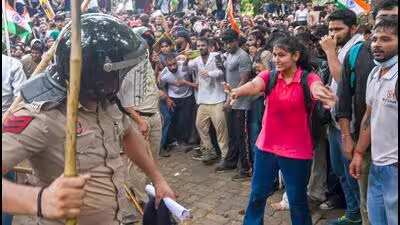
On Monday, tens of thousands of agitators marched to Parliament demanding Union education minister Dharmendra Pradhan’s resignation over repeated paper leaks. The protesters toppled barricades and moved closer, prompting the sealing of the gates of the Parliament complex for the first time since the 2001 Parliament attack. Commandos took up positions with automatic weapons.
Event Context
The Delhi Police said the planned but unauthorised march was handled “professionally,” but visuals showed security personnel in full riot gear thrashing young unarmed protesters.
Vijay Daniel, a protester who came from Hyderabad to join the march, said the violence erupted moments before it was to begin. “We were just getting into the bus to leave for the march. I was with Gitanjali ma’am when the officials barged into the vehicle and started pushing and hitting us,” he said, referring to educator Gitanjali Angmo, who has been at the forefront of the protest since the removal of her husband, activist Sonam Wangchuk, from Delhi’s Jantar Mantar protest site. Wangchuk’s hunger strike and forcible removal last week galvanised the protest movement.
Daniel said they were forced out and had to run to the protest site to save themselves. “…some people were already hit, and police started entering from both sides. I tried to hide under the stage. A doctor helping injured people also hid with me, but they found us, pulled us out, and then there was a blow to my neck. I fell to the ground. It felt like Jallianwala Bagh…we were surrounded from both sides, and the police just attacked us indiscriminately.”
Shivam Navani, 18, a student from Rajasthan, described the confrontation that unfolded around the barricades near Parliament. “We had just reached…when the police charged. I was hit when I was trying to protect a couple of girls who were being beaten up. They did not wait or see anything and just kept hitting. All we were trying to do was peacefully walk towards Parliament.”
Suhana Khan, 23, a student from Delhi, alleged that both uniformed personnel and men in plain clothes were involved in the action. “We were atrociously hit as if we were criminals. There were men in plain clothes carrying batons. Accompanying them were men in uniform. They beat us mercilessly and then detained us. Around 30 women were detained together. We called lawyers and leaders from political parties for help, but nobody turned up.”
David Lal Tongchangya, 29, a student from Mizoram, questioned the police allegation that protesters threw stones. “This is what this country has come down to. Students, young girls, were hit on their private parts. We were not even allowed to leave the protest site. We did not hit, argue, or pick a fight. We just wanted to walk, but they started a baton charge. There were so many sticks that it felt like a hailstorm. They now say we threw stones. How is that even possible when there are no stones here, and everyone is checked before entering?”
The Cockroach Janta Party (CJP) called for the march to Parliament after a 23-day-old sit-in hunger strike at Jantar Mantar. It was formed after Chief Justice of India (CJI) Surya Kant’s remarks referring to some people as “cockroaches” and “parasites. The CJI maintained that his remarks were not directed at the youth but at individuals who entered professions such as law and media using “fake and bogus degrees”.
The CJP garnered millions of followers on social media before launching a sit-in protest on June 6 demanding Pradhan’s resignation. Crowds swelled through the weekend, and by Monday morning, students and young professionals defied heavy barricading to join the protest.
Officials admitted they had underestimated the strength of the gathering. They put it at about 35,000. Protesters and eyewitnesses said the number was at least twice as much. Roughly 2,000 police personnel and 20 companies of paramilitary forces were deployed.
Delhi Police said protesters attempted to break multiple barricades and march towards Parliament despite restrictions in place. They alleged some resorted to stone-throwing, injuring personnel and damaging public property. Police said around 70 protesters were detained after the confrontation near Janpath and Parliament Street.
Match Outlook
Delhi Police said 118 personnel, including senior officers, were wounded. The exact number of injured protesters was not immediately known. Reports said the wounded could be in the hundreds. Officials at one government hospital confirmed “at least 100” protesters being treated for injuries. The police put the number of injured protesters at 60.
