
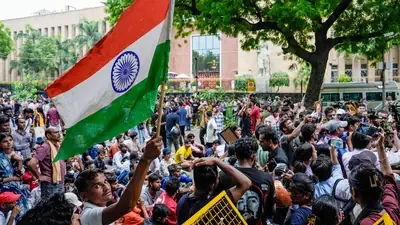
The Centre on Monday opened a channel of communication with the Cockroach Janta Party (CJP), with Union minister JP Nadda meeting two representatives of the outfit amid its ‘Chalo Sansad’ march in Delhi. CJP leaders claim they have given a written charter of demands and sought time to consult the BJP leadership before responding, marking the first formal engagement between the government and the protesters since the agitation intensified.
Dipke ends fast, Wangchuk seeks release
In a subsequent update, Ranka said he and Das remained at Nadda’s residence as discussions continued.
In another key development, CJP founder Abhijeet Dipke ended his indefinite hunger strike at the request of activist Sonam Wangchuk, who has been admitted to Safdarjung Hospital since July 18 after his own 21-day fast required medical intervention.
Wangchuk, meanwhile, appealed to hospital authorities to discharge him, saying his health parameters were normal and that he wished to join the ‘Sansad Chalo’ march.
In a note shared on X, Wangchuk said he was “feeling very fine” and requested permission to leave the hospital, even temporarily, so that he could participate in the protest.
Details
The meeting came even as thousands of CJP supporters attempted to march towards Parliament demanding examination reforms and the resignation of education minister Dharmendra Pradhan. The day saw heavy police deployment, barricading, lathi charge, detentions and traffic disruptions in the national capital.
CJP spokespersons Saurav Das and Ashutosh Ranka met Nadda at his residence on Monday afternoon after, according to the outfit, the government reached out earlier in the day seeking talks.
Before leaving for the meeting, Das posted on X: “Ashutosh Ranka and I, on behalf of the Cockroach Janta Party, are on our way to meet JP Nadda. The government had reached out for talks in the morning. Our demands are clear. The youth have gathered in huge numbers.”
Following the meeting, Das said the two leaders waited for more than two hours before getting around 10 minutes with the Union minister.
“After waiting for more than 2 hours, Ashutosh Ranka and I just met J.P. Nadda ji at his residence for 10 minutes,” Das wrote on X.
He said the delegation submitted a written memorandum outlining the CJP’s demands.
“While we submit a written letter with our demands, he has assured us that he will meanwhile speak internally. We are in that process. There is news of mass detention etc.,” Das added.
According to Ranka, the Union minister requested more time to align with the BJP leadership on the outfit’s key demands, which include the immediate release of activist Sonam Wangchuk, the resignation of Union Education Minister Dharmendra Pradhan, and ₹1 crore compensation for the families of all NEET aspirants who allegedly died by suicide.
There was no immediate official statement from the government on the meeting or whether any of the demands would be accepted.
Earlier in the day, Das had indicated that the organisation was willing to engage with the government despite the outreach coming after weeks of protests.
He said there was still no clarity from the administration on how it planned to address the protesters’ demands, adding that “the ball is in their court.”
The CJP has been demanding sweeping examination reforms and the resignation of Pradhan over alleged irregularities in competitive examinations.
The talks took place even as thousands of protesters gathered at Jantar Mantar before attempting to march towards Parliament under the banner of ‘Chalo Sansad’.
Police stopped the procession near Parliament Street with multiple layers of barricades. Protesters alleged they faced lathi charge, tear gas and mass detentions after refusing to disperse. Security across central Delhi was tightened as the Monsoon Session of Parliament commenced on Monday.
Many students participating in the march said they would continue their agitation until their demands were met.
Several protesters accused the government of failing to engage with students despite weeks of demonstrations, while others said they were determined to continue the movement until Pradhan resigned.
