
Every four years, hundreds of millions across the world gather in front of television screens to watch the football World Cup. Indians are no exception. From Kerala to Nagaland and from Gujarat to West Bengal, families, friends and fans of the game come together to root for their teams.
Event Context
Joining this global celebration is Nagaland, one of the eastern most states in India, whose towns and localities amid rolling hills spruce up in colours of flags of countries participating in the world cup.
“Here in Nagaland, football is numero uno. Just as cricket dominates the imagination of mainland India, here it is football – by many, many miles. And during the FIFA World Cup, it doesn’t just remain a sport… it becomes a way of life,” says Abu Metha, vice president Athletics Federation of India & secretary general Nagaland Olympic Association.
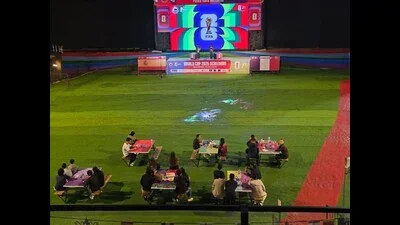
Here, mass midnight screening parties have become a part of the daily routine since the middle of June and the tournament has become a celebration despite the stereotype of insurgency associated with the state.
Football is not just celebrated during FIFA World Cup though. It starts from the village level tournaments.
Also Read: And now, for a final flourish
The legend of Dr T Ao
Nagaland is home to the legendary Dr. Talimeren Ao (also called Dr. T. Ao), who captained independent India’s first football team to the 1948 London Olympics. The national junior girls’ championship is named after him while in Nagaland, the inter-district tournament carries his name.
Last year, the 24th edition of the Dr. T Ao Trophy finale recorded a whopping 30,000 spectators at the Indira Gandhi Stadium in capital Kohima while almost 2,00,000 viewers followed the match online, solidifying the fact that Naga people’s love for the beautiful game is second to none.
This World Cup, in Mokokchung- the home district of Dr. T. Ao, a group of seven young football enthusiasts built a 15-foot-tall FIFA World Cup replica with bamboo strips on the side of National Highway-2. The same group of youngsters who are from Ungma, are involved in live streaming on big screen in the streets of their locality.
Support for Argentina
On Thursday morning, when the final whistle was blown in Atlanta, US in the semi-final match between Argentina and England, even the sound of rain was drown out by the echoing roar of joy at Ungma.
“We’re having the best time. The streets of Ungma went wild. Age was just a number this morning… mothers in their 70s, youth, children, everyone came out to the streets in celebration. There was bursting of fire-crackers. The celebrations went on for about two hours,” says Okumer Jamir, an entrepreneur who was involved in crafting the 15-feet World Cup replica.
In Phesama, a small hamlet about 10 kilometres away from Kohima, the football craze is taken a notch higher – building up the fervour from the FIFA World Cup, the village youth organises its own Mini World Cup every four years right after the World Cup. This event began in 1994, when the locals could not get over the heart-stopping FIFA World Cup final between Brazil and Italy.
They decided to settle their unending debate by organising their own final play-off – by picking out the best players in the village to represent their own version of team Brazil and Italy. Since then, the event became a tradition following every World Cup.
“The Phesama Mini World Cup involves everyone from the village irrespective of clans or khels. We (the youth group) currently have around 800 active members and we have ordered more than a thousand jerseys for our upcoming 8th edition,” Seyievilie Peter Zashümo, one of the organisers told HT.
Events across the state
In the state capital Kohima and commercial hub Dimapur, town councillors and business establishments have also joined the World Cup fever by organising mass screening parties, pulling huge crowds.
Residents of Mokokchung’s Akamen locality has developed a tradition of hoisting country flags along the footpaths and roadsides during major international football tournaments including the FIFA World Cup, UEFA Championship and Copa América.
All in all, the 2026 FIFA World Cup has not just reawakened the passion for football in Nagaland, but reinforced the people’s love for the game and the thrill that every match brings to them.
“That is the magic of football. It unites people across tribes, generations and communities. For a few precious weeks, it offers a joyful escape from the pressures and realities of everyday life and reminds us that happiness can be wonderfully simple. Of course, football also teaches one of life’s greatest lessons – you win some, you lose some. Every World Cup creates heroes, heartbreaks, unforgettable memories and endless debates that last another four years,” Metha added
On a note that hits more on reality, Chenonlo Aaron Woch of the Nagaland Football Association said the love for the beautiful game among Nagas is unquestionable but he feels there is a need for developing a football culture that extends beyond tournaments and fanfare.
“If our craze for the beautiful game and our connect with the World Cup and popular teams for which we are ready to lose our sleep on; and the European clubs for which we fight tooth-and-nail over are channelised towards building the local football culture and ecosystem, only then our football can grow,” he added.
Player Focus
“In rural villages, a simple inter-clan football match can draw as much support and cheer! Every person in the village come to watch the match and the crowd erupts in roars with every goal scored. Our craze for football is that high,” says Mechievilie Yashü, the state’s first national referee.
There is intense craze for Argentina in Ungma which was driven by the legacy of Diego Maradona in the 1980s and in the more recent times, Lionel Messi.
One of the unique aspects of the initiative is that most of the flags are handmade: residents purchase coloured fabrics where mothers assist in stitching the coloured cloths together while the youth paint the national emblems and designs.
Team Analysis
“Victories for Argentina, Portugal and other favourites spark spontaneous vehicle processions, celebrations and enough honking to make you think the trophy has arrived in Nagaland itself,” Metha said.
