
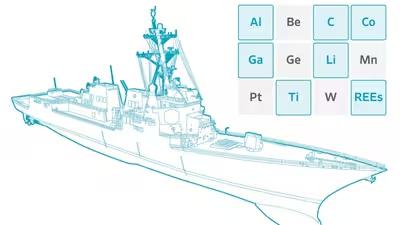
BRUSSELS—Europe’s effort to loosen Beijing’s grip on the materials it needs to rearm has hit an unexpected snag: the deep pockets of the U.S.
Market Context
The U.S. is far outspending Europe, sparking fears that an increasingly protectionist Trump administration will hoard the materials and leave Europeans dependent on China—and more vulnerable to its restrictions.
In the five years to February, the U.S. allocated around $46 billion for critical raw-material projects, an analysis by the French Institute of International Relations think tank found. That is roughly eight times the level allocated by the European Union in the same period, the institute said.
“The U.S. is much, much further ahead in creating a non-China supply chain,” said Andrea Paolo Lai, president of global operations at Swiss high-tech company Oerlikon, which has customers in the aerospace, energy and defense industries.
Western governments are scrambling for alternatives to China, which controls most of the global supply of critical raw materials. The efforts intensified after Beijing restricted rare-earth magnet supplies as part of a trade fight with the U.S. last year.
The Defense Department has ordered contractors to remove Chinese rare earths from their supply chains for magnets by next year.
The U.S. says it wants to work with allies to counter China’s dominance. Expanding the global pool of non-Chinese raw materials stands to benefit the EU as well as the U.S., officials from both economies say. The two sides signed a memorandum of understanding on critical raw materials in April, and European officials hope such cooperation can be a bright spot in an otherwise strained trans-Atlantic relationship. But some are wary of relying too heavily on a partner they say has undermined trust by imposing punitive tariffs and threatening to seize Greenland.
The U.S.’s Export-Import Bank offers financing for critical-materials projects in which foreign entities supply American companies.
The U.S. is spending to realign supply chains on a scale that is unmatched globally, said Atherley, who is also Pensana’s founder. “This is almost friendly fire to other Western countries,” he added.
Europe’s effort to secure materials outside the continent has hit hurdles. The EU’s industry commissioner learned the U.S. beat him to a rare-earth deal in Brazil three days before he was due to travel there. “We were told that the Americans had stopped by, put money on the table, and bought up all production until 2030,” he told a Dutch newspaper last year.
Brazil-based rare-earth miner and processor Serra Verde Group said earlier this year that it had secured a $565 million financing package from a U.S. government agency. The company later disclosed that it had entered a 15-year deal to sell its magnetic rare earths to a special-purpose vehicle, capitalized in part by the U.S. government.
USA Rare Earth is now acquiring Serra Verde, having bought U.K.-based rare-earth specialist Less Common Metals last year.
Even on the spot market, U.S. companies seem to have the upper hand. American customers act faster and are willing to pay more to secure critical materials, said Tim Borgschulte, head of finance at Berlin-based commodities trading house Noble Elements.
Still, American efforts to build Western supply chains have the potential to benefit Europe.
Germany’s Vacuumschmelze, which makes rare-earth permanent magnets and is currently owned by a U.S. private equity company, said its planned acquisition by Colorado-based Energy Fuels will provide better access to the materials it needs. The deal “will strengthen Germany’s and Europe’s independence in critical rare earth components,” Vacuumschmelze Chief Executive Erik Eschen said.
Europe has also taken steps to secure critical materials of its own. The bloc is planning a 3-billion-euro financing hub to support alternative supplies, that is equivalent to $3.43 billion. A group of EU countries is working on a pilot project to stockpile critical materials and the bloc has raw-materials partnerships with more than a dozen countries, including Canada, Argentina, Norway and South Africa.
Company Performance
To curb reliance on China, the U.S. is handing out grants, loans and tax breaks to boost American production, and negotiated preferential access to mineral wealth in war-torn countries. American companies are acquiring producers outside the U.S. or inking deals to buy their materials.
A European Commission spokeswoman said the EU is confident its approach will yield results. By 2030, the bloc wants to increase domestic production and make sure that no country supplies more than 65% of the EU’s annual strategic raw material needs.
Working with the U.S. and other countries complements EU-level efforts to diversify, the spokeswoman said.
Bernd Schäfer, chief executive of EU-funded EIT RawMaterials, said the Europeans should take a page from the U.S.’s more decisive approach.
“While we’re talking,” Schäfer said, “the next value chain is bought by the Americans.”
Write to Kim Mackrael at [email protected]
Competitor Comparison
“The U.S. can be a partner in developing alternative sources, but it can also be a competitor,” said Camille Grand, secretary-general of the Aerospace, Security and Defense Industries Association of Europe. He doesn’t think the U.S. would deliberately hold back materials from an ally, he added, but if supplies run low, Americans would likely focus on their own needs first.
The White House didn’t respond to a request for comment.
Critical raw materials, such as rare earths, are also crucial for semiconductors and to the bloc’s transition away from fossil fuels.
The U.S. approach is multipronged and speculative. Washington has negotiated preferential access to minerals in the Democratic Republic of Congo—the world’s top cobalt producer—and in aspiring EU member Ukraine.
Source
Pensana, a U.K.-based mining company with operations in Angola, scrapped plans for a British processing plant last year to pursue a U.S.-based option. Pensana is currently negotiating for up to $160 million in debt financing backed by the Export-Import Bank, which is conditional on it selling rare-earth products directly into the U.S., according to company chairman Paul Atherley.
