
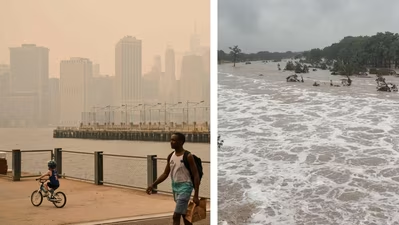
Wildfires are burning through the boreal forests of central Canada, blanketing Toronto and sending smoke across the border to choke Detroit, Chicago, Minneapolis and New York. Flash floods have submerged parts of the Texas Hill Country, one year after a deluge that killed more than 130 people in the same region. California’s Sierra County is burning. Washington DC has been sweating through a heat index close to 40°C. And roughly 64 million Americans on Thursday were dealing with both high temperatures and dangerously polluted air, according to the US Weather Prediction Center, which is part of the National Weather Service.
Questions over Fifa World Cup final
Behind the overlapping crises are a persistent drought across much of North America, a stalled high-pressure system that has trapped smoke close to the ground, a jet stream funnelling Canadian smoke southeast, and a heated atmosphere that holds more moisture and dumps it as extreme rain. Each of these has become more likely as global temperatures rise, scientists say.
About 5.9 million acres — roughly 2.4 million hectares — have burned across Canada so far this season. Ontario’s government has asked Ottawa to prepare help for evacuating remote communities in the north, including the possible deployment of Canadian troops, Bloomberg reported. The Ontario Provincial Police said 15 communities and their surrounding areas had already been evacuated.
Northern Minnesota is contributing its own smoke. In the Boundary Waters Canoe Area Wilderness — a 1.1-million-acre (445,000-hectare) expanse accessible mostly by canoe — about 17 fires triggered by lightning more than a week ago have spread rapidly, the Associated Press (AP) reported.
A high-pressure system has trapped the smoke close to the ground, said Steven Freitag, an NWS meteorologist in Detroit, where visibility in places fell to half a mile.
Roughly 47% of the contiguous United States is in drought. Large parts of eastern and western Canada are as well. A warmer atmosphere holds more moisture, producing heavier bursts of rain, and drives more evaporation, which dries out vegetation and provides fuel for wildfires. Scientists refer to hazards that arrive together or in quick succession as “compound events”.
“It’s basically a river of smoke pouring into the Midwest right now,” Emily Fischer, an atmospheric chemist and professor at Colorado State University, said.
She added, “This is a direct connection to climate change. This is the climate change that people breathe.”
Dan Westervelt, an associate professor at Columbia University’s Climate School, described the combination of severe drought and heat in Canada and the US as “a perfect storm for really dry conditions to provide a lot of fuel for these wildfires to burn”.
The overlap of heat and smoke carries a compounded health risk.
The dangerous conditions in the New York metropolitan area come days before the Fifa World Cup final between defending champions Argentina and European champions Spain is scheduled at the open-air stadium in New Jersey on Sunday (local time). More than 80,000 spectators are expected at the venue and another 50,000 at a public screening in Central Park, Manhattan.
Team Analysis
Officials from Minnesota to New Jersey have urged residents to stay indoors, distributed KN95 face masks, and cancelled and postponed outdoor events – including a Major League Soccer (MLS) match in Chicago, municipal swimming pools and nature camps in Minneapolis, and a Creed concert at the Mystic Lake Amphitheater near the city.
Rangers estimated that between 6,000 and 10,000 people were inside when the wilderness was closed on Tuesday. Most of them had been evacuated by Wednesday, though some campers had to paddle for hours between advancing walls of flame. The Royal Canadian Air Force also airlifted 11 Minnesota teenagers and four staff members from a provincial park north of the border.
Gupta said hydration breaks would need to be more frequent than the two provided in every game and suggested that immunocompromised fans consider selling their tickets and watching from home. Fans with health issues who chose to attend should wear masks in the stadium, he added.
Match Outlook
“There will be fire on the landscape until fall, and some fire will be burning until snow cover,” Karen Harrison, a spokesperson for the state and federal agencies coordinating the response, told AP.
Frank Pereira, a senior branch forecaster at the US Weather Prediction Center, said the record-breaking temperatures earlier expected across the mid-Atlantic had not fully materialised. “It will still be warm for sure, but not quite the intensity that we were previously going with,” Pereira told Bloomberg.
In central and western Texas, the story was water. Flash floods wrecked bridges and closed dozens of highways between San Antonio and the border town of Del Rio, prompting mandatory evacuations across the Hill Country.
As much as 9 inches (23cm) of rain fell in some places in just a few hours, and a further 8 inches were forecast through Friday morning, Bloomberg reported. Some areas could receive close to 30 inches (76cm) in 72 hours, said Hatim Sharif, a University of Texas at San Antonio professor who studies flash flooding.
Texas Governor Greg Abbott declared a disaster in 59 counties and mobilised more than 1,300 emergency workers. More than 75 people had been rescued by Wednesday night, and one person died during an attempted rescue in Travis County, KEYE-TV reported, citing a county spokesperson.
The Guadalupe River, near which more than 25 girls and staff members at a summer youth camp perished in July last year, rose 32 feet (9.8 metres) in four hours, the NWS said in a social-media post. Two of the camps along its banks — Camp Waldemar and Camp Stewart — said all campers and counsellors were safe. A camp run by the Children’s Association for Maximum Potential was sheltering in place. The Leona River near Uvalde was also overflowing.
Deaths have been fewer than in last year’s disaster in part because early-warning systems have been enhanced and people have grown more cautious about camping near Hill Country rivers, said Philip Bedient, a Rice University engineering professor who founded the university’s Severe Storm Prediction Center.
“These are very rapidly moving rivers and once you’re swept away, you’re definitely in harm’s way. But having said that, I still think that there’s much greater awareness now compared to what happened a year ago,” Bedient said.
Also read: El Niño to amplify in coming months, likelihood of extreme weather events: WMO
“Extreme heat is expected during this season, but what is new in the context of climate change is really to have simultaneously extreme heat and wildfire smoke. We need to get used to that because it’s not going to be exceptional anymore,” Tarik Benmarhnia, professor of epidemiology at the University of California at San Diego, said.
A study published this year found that long-term exposure to fine particulate matter from wildfire smoke contributed to an average of 24,100 deaths a year in the lower 48 US states.
Air quality in New Jersey was rated “unhealthy for sensitive groups” by several monitoring platforms. AccuWeather meteorologist Alex DaSilva told Reuters that rain forecast for Saturday should dissipate much of the smoke, with a cold front expected to move through on Sunday morning. “It should kick out any remaining smoke that we’re seeing,” DaSilva said.
Despite the expected relief, medical experts said the combination of residual smoke and heat could pose risks by the 1500 Eastern time (1900 GMT) kickoff. “It not only is going to be terrible, terrible air quality. It’s hot, and that can cause an extreme amount of stress on the heart,” Dr Vin Gupta, a pulmonologist and board of directors member at the American Lung Association, said.
source
Detroit registered the worst air quality of any city in the world on Thursday, according to the monitoring firm IQAir, with a pollutant index (AQI) of 600 — twice the level classified as hazardous by the US Environmental Protection Agency (EPA), Reuters reported.
Most of the smoke drifting over the American midwest and northeast has originated in Ontario and other parts of central Canada. As of Thursday morning, 858 wildfires were burning across Canada, of which 111 were considered out of control, according to government data. Most were in the central provinces of Manitoba, Saskatchewan and Ontario.
Minnesota’s northeastern Iron Range, including the cities of Duluth and Hibbing, recorded fine-particulate concentrations of up to 900 micrograms per cubic metre — triple the threshold for hazardous air, according to the state’s Pollution Control Agency.
Chicago’s air quality index topped 300 on Thursday, the reading at which the EPA classifies air as “hazardous” for everyone regardless of health status.
Also read: Why India needs to see temperature from space
Temperatures across large parts of the country have been unusually high for this point in the summer. Minneapolis was forecast to stay at temperatures over 32°C for the rest of the week.
In several cities, the wildfire smoke has kept temperatures below what forecasters had earlier predicted.
