
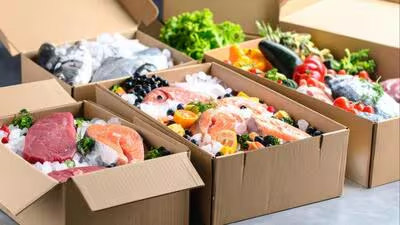
MUMBAI: A company selling both chilled and frozen products was struggling to scale as India didn’t have a proven cold chain infrastructure for stocking, delivery and retail of items requiring four degrees to minus 16 degrees temperatures. It expanded operations very slowly to 8-10 cities, eventually reaching 18-20 cities. But the advent of quick-commerce platforms such as Blinkit, Zepto, Instamart etc in the last two years proved to be a blessing for this firm which rode on their delivery infrastructure and suddenly found access to 120 cities.
Event Context
“That’s what quick-commerce — the online shopping channel with home delivery of products in 10-30 minutes — has done for the frozen foods and ice creams category,” said Angshuman Bhattacharya, national leader, consumer products and retail at EY India, without naming the brand.
The steep cost of deploying and maintaining chillers and freezers at neighbourhood kirana stores and lower consumer familiarity with frozen foods has historically prevented many smaller companies from expanding. For years, frozen foods availability was restricted to select modern trade outlets and the penetration of freezers in general trade still remains low. “So as they stepped in, the quick-commerce platforms pushed both ice cream and other frozen food sales as shared logistics infrastructure for scores of brands they onboarded made it economical to do so,” Bhattacharya said.
Player Focus
Ashu Phakey, vice president and business head, frozen and fresh foods at ITC Ltd. said the rise of quick commerce is a positive development for the frozen foods category. “By improving accessibility, visibility and discoverability, these platforms have made it easier for consumers to access frozen products as part of their regular grocery purchases,” he said. For ITC Master Chef, it has emerged as an important channel that complements traditional retail formats, Phakey said. “Quick commerce players have built temperature-controlled storage and delivery capabilities that are critical for the frozen foods category,” he added.
Gaurav Kwatra, CMO, iD Fresh, that makes idli-dosa batters, agreed with Phakey: Quick commerce has accelerated consumer access to fresh food by making it available within minutes which aligns with changing consumer lifestyles. “These platforms have invested significantly in their own dark store and cold storage infrastructure to support fresh and chilled products. As brand partners, our role is to ensure that products reach these fulfilment centres while maintaining the required quality and temperature standards. Together, brands and quick commerce platforms have strengthened the overall cold chain ecosystem,” Kwatra said.
Frozen foods is already a serious category on quick commerce, pointed out Mrigank Gutgutia, partner, consulting, at Redseer Strategy Consultants. “We estimate frozen ready-to-cook on quick-commerce at roughly about ₹3,200 core in calendar year 2025, up nearly 88% over the previous year. It’s now growing a bit slower than overall quick-commerce, which is usually the sign of a category that has moved past its early explosive phase and settled into being an established one,” Gutgutia said.
Team Analysis
Besides its flagship idli and dosa batter, iD Fresh has also expanded its range to include speciality offerings like protein and appam batter, and chapati. “Quick-commerce has become an important distribution channel by improving accessibility and availability of fresh products. It encourages product trial and repeat purchases, particularly among younger consumers…While modern retail and general trade continue to remain important channels for us, quick- commerce has further strengthened our reach and consumer accessibility,” iD Fresh’s Kwatra said.
This summer, ice creams too exploded on the channel with brands like Hocco, Go Zero and NIC doing particularly well. In May, its sales on quick-commerce touched ₹560 crore, up by 140 % over the same period last year. Without naming brands, Gutgutia said some new-age ice cream brands draw 70% or more of their revenue from quick commerce. “Others are using q-comm as a test bed to enter new states and customer segments. The additional unlock enabled by q-comm in ice creams is premiumization and multiple purchase windows throughout the day,” Gutgutia said.
Q-comm apps haven’t so much built deep cold storage as they’ve built unmatched last-mile density, he said. “The dark store is still largely an ambient facility, with roughly 90% of what it holds being dry goods and only about 10% cold. The real transformation is proximity: there are already 6,000-plus dark stores across the country,” he added.
Match Outlook
Though Phakey believes that India’s frozen foods ecosystem has evolved significantly over the years, going forward, continued investments in cold-chain infrastructure across retail channels will be key to expanding access and supporting the category’s next phase of growth.
Kwatra also emphasised on strengthening the cold chain ecosystem which will be critical to meet increased consumer demand for minimally processed foods. Investments in refrigerated transportation, cold storage infrastructure, retailer capabilities and last mile temperature management will help improve efficiency across the value chain, he said.
source
According to Redseer analysis, on quick commerce, 47% of frozen ready-to-cook sold is vegetarian. “Frozen veg snacks like smileys, aloo tikkis and mini samosas, together with peas, make up close to 40% of the market on their own,” Gutgutia said.
