
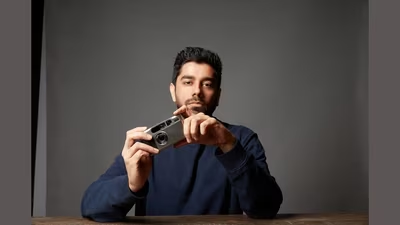
Celebrity photographer Rahul Jhangiani has spent over a decade behind the lens, capturing some of India’s biggest stars, from Alia Bhatt and Virat Kohli to Kareena Kapoor and Ranbir Kapoor. In this exclusive conversation with HT Lifestyle, he opens up about photographing celebrities, the evolution of visual storytelling, fashion campaigns and the changing face of celebrity culture in India. (Also read: Inside Prince Azam Jah’s royal life: Son of Hyderabad’s 8th Nizam shares rare stories of palaces, culture and legacy )
How many photographs do you typically shoot during a celebrity session, and how do you narrow them down to the final few that the world sees?
For me, the most intensive part of the creative process actually happens before and after the shoot. It all begins with a brief from the agency or the client. From there, my in-house creative team, along with the agency and the client, brainstorm ideas to ensure we’re aligned with the brand’s vision, objectives, and identity.
We then develop a mood board together, which becomes the creative blueprint for the project. Once that’s approved, we have a pre-production meeting (PPM) where every detail, from styling and lighting to locations and logistics, is discussed thoroughly. The idea is to walk onto the set knowing exactly what we’re creating, so there are no unnecessary surprises on the day of the shoot.
The shoot itself is where all the planning comes together. Once it’s completed, we carefully shortlist the best images, send the selected photographs for post-production and retouching, and finally deliver the finished images to the client.
One shoot that will always stay with me is my first major advertising campaign for Lux with Alia Bhatt. At the time, I was still very new to the industry, so getting the opportunity to shoot such a prestigious campaign was a huge milestone in my career.
The number of photographs we shoot really depends on the celebrity and the nature of the brief. Sometimes we may capture just 50 to 100 frames, while on larger campaigns or more elaborate shoots, that number can easily run into the thousands. It all comes down to the concept, the pace of the shoot, and how quickly we achieve the desired images.
I prefer having a strong selection of photographs because it gives both the client and the celebrity enough options to choose from. The final edit is always a collaborative process involving the client, the celebrity, and me. We narrow the selection by balancing the client’s creative brief, the celebrity’s preferences, and my own perspective as the photographer to arrive at the final set of images that everyone is happy with.
I wouldn’t necessarily call it my most challenging shoot, but it was definitely the one that made me the most nervous. I photographed Hailey Bieber, back when she was Hailey Baldwin, during Paris Fashion Week for a beauty campaign.
Luxury campaigns, on the other hand, require a different mindset. Before the shoot, you need to understand the brand’s identity, study its visual language, and work within a clearly defined set of creative guidelines. Every image has to feel consistent with the brand’s values and aesthetic.
That said, luxury brands also encourage creativity. The difference is that your creativity has to serve the brand’s identity rather than exist independently. It’s about finding the perfect balance between your own vision and the brand’s established visual language.
I wouldn’t call them mistakes because every photographer has their own journey and learns at their own pace. However, one thing I do notice is that many young photographers tend to rely heavily on technology while overlooking the art and craft of photography.
Today’s cameras and tools make it easier than ever to create technically good images, but photography is ultimately about storytelling, perspective, and emotion. Technology should support your vision, not define it.
My advice would be to keep shooting as much as possible. The more you photograph, the more experience you gain, and over time you’ll naturally develop your own visual style and creative voice. That’s what ultimately sets a photographer apart, not just the equipment they use.
Team Analysis
At the time, I was still quite new, and I had travelled to Paris without my regular team. While we had local production support, it’s very different from working with people who know your style and workflow. So there was a lot of pressure, and I had to manage much of the process on my own.
What made the experience memorable was Hailey herself. She was incredibly warm, professional, and accommodating. She made sure I had enough time to get the shots I needed, which really helped put me at ease. By the end of the shoot, what started as a nerve-wracking experience became one of the most rewarding shoots of my career.
Match Outlook
The campaign was shot in Bangkok, and it was a defining moment for me. Alia was also at the beginning of her journey, and being trusted with a brand of that scale gave me incredible confidence and exposure. It opened many doors professionally and marked the beginning of a new chapter in my career. Looking back, it’s a shoot I’ll always be grateful for because it changed the trajectory of my work.
I believe the key is to adapt. The creative industry has always evolved with new technology, and AI is simply the next step in that journey. Rather than seeing it as a threat, I see it as a powerful tool that photographers should learn to work with.
We’ve already started integrating AI into parts of our workflow. It’s made post-production more efficient, and it’s also incredibly useful during the pre-production stage. For example, creating mood boards that once took hours of research can now be done much faster, allowing us to spend more time refining ideas instead of searching for references.
That said, I don’t think AI can replace the essence of photography. The emotion, spontaneity, and human connection you capture in a real photograph are incredibly difficult to recreate artificially. So for me, AI is an opportunity to enhance the creative process—not a replacement for it.
Photography trends are constantly evolving, and that’s what makes the industry so exciting. A few years ago, the focus was on highly polished, futuristic imagery with extensive post-production. Today, we’re seeing a strong return to film-inspired aesthetics—natural grain, candid moments, direct flash, and a more raw, nostalgic visual style.
These shifts are a reminder that trends are cyclical, and they’ll continue to change with time. While it’s important to stay aware of what’s current, I also believe every photographer should have a distinct visual identity. Trends can inspire your work, but your own style and perspective are what make your photographs memorable and timeless.
They’re actually two very different creative experiences. When you’re shooting an editorial or a magazine cover, you have a lot more creative freedom. It’s an opportunity to experiment, push boundaries, and create images that are more expressive and artistic. There are very few limitations, so it’s a space where you can really explore new ideas and visual styles.
