
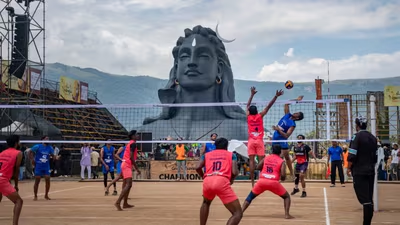
Sports may begin as a personal interest, influenced by the games people enjoy watching or playing in their leisure time. But it can also become part of a community’s cultural rhythm, transcending differences of social identities, strengthening collective identity and gradually evolving into a way of life.ALSO READ: A spiritual perspective: Sadhguru explains how emotions can influence every part of your life
Event Context
This cultural role of sports is reflected in Isha Gramotsavam, which intends to make sports part of everyday village life, which helps in reviving the collective spirit of rural India.
Organised by Isha Outreach, the social development wing of Sadhguru’s Isha Foundation, Isha Gramotsavam is referred to as ‘the country’s largest annual rural sports festival.’ Its 18th edition, this year, in particular, marks a significant expansion, as the tournament moves beyond the rural regions of southern India to include Uttar Pradesh, Haryana, Himachal Pradesh, Odisha and Maharashtra for the first time.
Speaking to HT Lifestyle in an interview, Swami Pulaka, national coordinator of Isha Gramotsavam, explained how the sporting culture continues even after the tournament ends, highlighting the lasting impact of the initiative.
“Over a period of time, sport has now become part of their (rural) culture. During important village festivals such as Ganesh Chaturthi and Makar Sankranti, the villagers themselves organise volleyball and throwball tournaments,” he said.
Nandhini, a 36-year old mother and captain of the PG Pudur throwball team, has led her team to become one of the most successful in the tournament. They won the championship in 2023, finished runners-up in 2024 and secured third place in 2025. She is also a physical education teacher in Devarayapuram village, Tamil Nadu, where she helps nurture young talent. Her journey tells us how access to sporting opportunities can build leaders and encourage young children to see a future in the field. The right mentorship is essential to keep sporting culture alive in the village.
Similarly, Manikandan, a 33-year-old fisherman from Uthamasolapuram village, led his team to victory at Isha Gramotsavam 2025 and was named the tournament’s Most Valuable Player (MVP)
His journey shows how grassroots tournaments can give rural talent a platform and greater visibility, which helps to bring vital resources back to the community, necessary for its development. With adequate resources, sporting infrastructure can improve, allowing sport to remain actively in practice and continue to be a sustained part of village life.
Player Focus
Let’s take a closer look at how sport is changing village culture and emerging as a catalyst for rural development.
The transformative power of sports can be strongly felt in the villages, where it acts as an effective tool for social empowerment and development. When people practise, train, compete, watch and celebrate together, rigid social and gender barriers that impede social cohesion and community development begin to soften.
By cutting across differences of caste, gender, and age, the unwavering spirit of sportsmanship is woven into the fabric of community life, and sports becomes a lasting cultural habit, paving the way towards social development in rural regions.
Sport has now become a natural part of life in the villages where Isha Gramotsavam has been conducted, and residents have participated. Most importantly, the initiative is also designed to sustain this involvement over the long term. Pulaka emphasised that Isha Gramotsavam is not a one-time engagement: “We have been conducting it (Isha Gramotsavam) continuously since 2004. Our volunteers remain in regular touch with the players and organise periodic coaching camps to ensure that they continue playing.”
This again brings us back to the larger idea of sports acting as a catalyst for development. Substance abuse can become a serious hurdle to rural progress by affecting wellbeing, livelihoods and human potential. Sport, however, constructively addresses this. As villagers become more invested in sportsmanship through active participation in annual events, Pulaka revealed that they often begin to embrace healthier lifestyles on their own to become better players.
“Once people begin playing sport, its competitive nature pushes them to improve. If they want to perform better, they start looking at what can help them become stronger players. Adopting a healthy lifestyle and abstaining from drinking and smoking naturally improve their game,” Pulaka said.
His performance also gave him a lot of exposure, earning him a place at the Chennai Blitz training camp, where he trained alongside professional volleyball players. This recognition is impactful and is helpful back home as well. With his prize money, Manikandan helped upgrade sporting facilities in his village.
This is why grassroots sporting events are so important: they can uplift entire communities, support social development and help reduce caste and gender-based barriers. Rural sport has the potential to be a development tool, and when it becomes a part of the local culture, the impact goes beyond the playing field.
Team Analysis
Another positive side of this initiative is that it encourages participation across age groups, with even women above 65 stepping onto the playing field and challenging ageist stereotypes. Pulaka acknowledged that women initially faced questions about why they were not sticking to traditional gender roles, such as staying at home and cooking for family.
Older women, in particular, had to deal with both sexist and ageist attitudes. To make them feel comfortable, Pulaka shared that volunteers first began playing with them inside their homes and living rooms. Once they gained confidence, slowly, they were encouraged to step outside and join others. Today, commendably, there are teams in Isha Gramotsavam where older women play alongside their children and grandchildren, showing how sport can create an inclusive space for intergenerational camaraderie.
We have already seen how sports can become a driving force for active community transformation. Swami Pulaka shared the journeys of two participants who emerged as role models through Isha Gramotsavam.
Match Outlook
The scale of this event is grand, as it is expected to bring together more than 80,000 players from over 40,000 villages through nearly 7,000 teams, including 15,000 women. Men will compete in volleyball, while women participate in throwball.
