
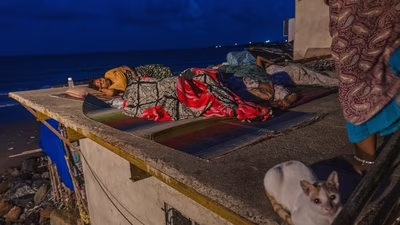
A new analysis found that India was among the countries worst affected by heat-related sleep loss, with cities in southern India losing 78-91 hours of sleep a year to high nighttime temperatures, including 8-9 hours attributable to climate change.
Market Context
The report, ‘Climate Change is Costing People (2020-2025) by Climate Central, noted that the burden falls hardest on older adults, women, low-income households and those without cooling, and was amplified by the urban heat island effect in dense cities.
Global average annual heat-related sleep loss in 2020-2025 was calculated at 56 hours and about 10% of this was due to climate change. West Asia topped this chart, with cities in Saudi Arabia, Oman and the UAE losing 12 to 16 hours a year to climate change. Parts of Southeast Asia and West Africa made up the next rung.
Also read: Delhi’s temperature read 37°C. It felt like 53°C. Here’s why that is dangerous
Chennai recorded the highest overall loss among major metros at 93 hours a year, followed by Mumbai (84) and Kolkata (80). Delhi lost 66 hours, the assessment found.
State-wise, Tamil Nadu, Kerala, Andhra Pradesh, Karnataka and Telangana logged the most sleep loss. Puducherry topped the state/UT list at 92 hours per person a year, followed by Andhra Pradesh (88.6) and Kerala (88.3). Persistently hot, humid nights drove sleep loss there.
Also read: Why India needs to see temperature from space
Tamil Nadu showed the strongest climate-change signal, with 7.9 additional hours of sleep lost per person a year — the highest in the country. Karnataka (7.8) and Rajasthan (7.0) followed, despite lower overall losses than the southern coastal states.
Also read: The new heat threat: Why India’s cities are feeling hotter even after monsoon arrives
Sleep depends on the body cooling itself, and warmer nights interfere with that process
Higher nighttime temperatures cut both sleep duration and quality.
The effects are strongest in the hottest periods, in warmer regions and among vulnerable groups.
Poor sleep is linked to impaired mood, cognition, productivity, and cardiovascular and immune health.
Losses accumulate over repeated nights, so even modest reductions add up across a hot season.
