
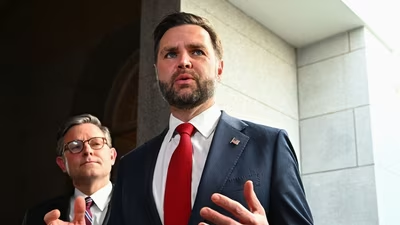
US Vice President JD Vance recently, on a podcast, admitted that the Trump administration mishandled its communication surrounding the release of the Jeffrey Epstein files, acknowledging that the rollout fuelled public mistrust but denying any attempt to conceal information.
Latest Update
“If people want to say we mishandled the Epstein release, guilty. We did mishandle it — especially the communications of it,” Vance said during a lengthy podcast interview with Joe Rogan released on Wednesday.
“We absolutely screwed up the comms of the Epstein files. Like, we just did,” Vance said, while insisting the communication failures were not an attempt to hide anything.
Also Read | Trump launches ‘massive leak hunt’ after report claims aides held Epstein strategy meeting without him”
Vance largely blamed the confusion on former Attorney General Pam Bondi, who had previously claimed that an alleged Epstein “client list” was “sitting on my desk right now.”
Jeffrey Epstein, a convicted sex offender, was known for his extensive connections to political, business and entertainment elites.
During the interview, Joe Rogan remarked that “most people think Epstein was Mossad.”
Vance replied, “Ya. Mossad or CIA or some other deep state, whether in America or Israel… He clearly had connections to the highest levels of American intelligence. He clearly had connections to the highest level of Israeli intelligence.”
The Justice Department under Bondi had also distributed binders titled The Epstein Files: Phase 1 and Declassified to conservative commentators and influencers, fuelling expectations of major disclosures.
Defending Bondi, Vance said he did not believe there was any malicious intent behind her remarks.
“I know Pam. I like Pam. I don’t think there was anything malicious going on,” he said, adding that Bondi was trying to respond to the political moment but “overstated what we had and what we didn’t have.”
Also Read | ‘Trump was jealous, washed money’: 5 bombshell claims made in latest Epstein files release
The Epstein files controversy dogged the Trump administration for much of last year before lawmakers passed a measure compelling the release of a large cache of documents related to federal investigations into the disgraced financier.
Separately, the US Department of Justice said on Wednesday that it was legally prohibited from releasing unredacted Epstein files requested by New Mexico, escalating a dispute with state officials conducting their own criminal investigation into the late sex offender.
New Mexico Attorney General Raul Torrez accused the Justice Department of deliberately obstructing the state’s probe by failing to provide the requested records.
He said the US Attorney’s Office for New Mexico responded on July 10 with just 31 pages of documents that had already been made public, contained unusable redactions or consisted of photocopies of local news reports.
Responding to the DOJ’s position, New Mexico Justice Department spokesperson Lauren Rodriguez said federal prosecutors routinely seek modifications to protective orders to share evidence with state law enforcement agencies conducting criminal investigations.
Pressure from Epstein survivors and advocacy groups for the federal government to release the files in full has continued to weigh on US President Donald Trump, who has repeatedly said the country should move on from the issue.
Meanwhile, New Mexico’s legislature is conducting a parallel investigation. Last month, its Truth Commission subpoenaed US Attorneys’ Offices in three states and the US Virgin Islands for information on whether they investigated Epstein and declined to file charges.
The commission is expected to release an interim report later this month, while Torrez has yet to announce any findings.
(with inputs from agencies)
Details
According to Vance, the episode led to Bondi being heavily criticised and caused people to mistrust the administration’s transparency efforts on the Epstein files.
The Justice Department began releasing the records in late December, including photographs, call logs, grand jury testimony and interview transcripts, according to a Reuters report.
