
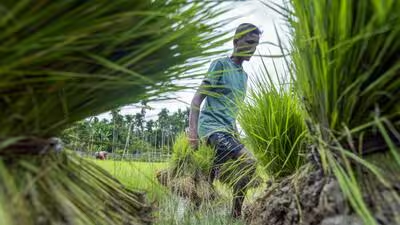
Nashik onion farmer Karbhari Jadhav lost nearly a quarter of his crop after unseasonal rains lashed Maharashtra in April. Yet, the 48-year-old is more optimistic than he was a year ago.
Market Context
Last year, Jadhav struggled to sell his onions for more than ₹12 a kg. This season, wholesale prices have already climbed to ₹27-28 a kg as lower rabi stocks and fears of a weak monsoon push prices higher.
More than half of India’s districts have received deficient or largely deficient rainfall so far this monsoon, highlighting the uneven spread of rains despite the nationwide shortfall appearing less severe. According to the India Meteorological Department (IMD), 53% of districts are currently classified as either deficient or largely deficient, even though cumulative rainfall across the country is only 21% below the Long Period Average (LPA). The disparity shows that while some regions have received adequate rain, large parts of the country continue to face prolonged dry spells that could hurt kharif crops.
This effect is likely to compound for rain-fed crops such as pulses, soybean and maize, for which the timing of rainfall often matters more than the seasonal total. Long dry spells during sowing and the early stages of crop growth can reduce yields even if rainfall catches up later.
The first signs are already visible in retail markets. Data from the department of consumer affairs show onion prices were nearly 20% higher than a year ago as of Tuesday and almost 33% higher than a month earlier. Potato prices have risen almost 11% over the past month. Among pulses, urad prices were up nearly 4% from a year ago and tur about 2%. Edible oils continue to trade 12-17% higher than last year.
“The market is pricing what could happen over the next two months, not what is available now,” a local trader from Indore said. “Despite comfortable inventories, domestic soybean prices are trading at nearly twice global levels because traders have begun factoring in the possibility that an El Nino-affected monsoon could reduce the size of the upcoming crop.”
Lower rainfall can reduce fodder availability, raising feed costs for livestock and poultry. Maize, a key ingredient in animal feed, has seen sowing decline nearly 20% to 5.6 million hectares as of July 10. Retail prices already reflect some of this pressure, with milk prices up nearly 3% from a year ago, ghee 5% and eggs more than 8%.
For now, the market has rewarded Jadhav. Whether the monsoon does the same will become clear over the next fortnight.
Company Performance
“I’ll more than make up for the production losses through better prices,” Jadhav said.
Economists caution that some increase in prices of perishable vegetables is common before the monsoon because intense summer heat affects supplies. However, delayed or deficient rainfall can amplify those gains as traders begin anticipating lower kharif output. “Perishable vegetables such as potatoes and tomatoes often become costlier during May and June because of the summer heat. A part of the increase this year is also because of concerns that delayed monsoon rains may affect production after the kharif season,” Yuvika Singhal, economist at Quanteco, explained.
Competitor Comparison
Government wheat stocks stood at 42.8 million tonnes, compared with 35.7 million tonnes a year earlier. Rice stocks remain comfortable at 38.95 million tonnes, while the Centre has also built a pulse buffer of about 4.5 million tonnes through procurement and imports. These stocks give the government room to release supplies or step up imports if shortages emerge.
Future Forecast
The temporarily higher prices have eased Jadhav’s immediate worries. But as he prepares to sow the next crop, uncertainty hovers. Like millions of farmers, he needs steady monsoon rains over the coming weeks. While farmers fear patchy rainfall could reduce this year’s harvest, wholesale traders have already begun pushing up prices of onions, pulses, edible oils and some vegetables on expectations of tighter supplies in the months ahead.
Those concerns are already becoming visible on the ground. According to Garima Jain, chief executive officer at Torq Commodities, lower rainfall since July 8 in parts of Madhya Pradesh, Maharashtra, Karnataka and Gujarat has pushed up temperatures and reduced soil moisture. “With similar conditions expected for the next 7-10 days as well, we can confidently say acreage under pulses, millets and oilseeds is likely to decline,” she said.
After recording its driest June since 2009, the IMD expects below-normal rainfall for both July and the monsoon season as a whole. It has forecast July rainfall at 94% of the LPA and seasonal rainfall at 90% of the LPA. Global forecasts have also turned more pessimistic. In its latest fortnightly outlook, the Australian Bureau of Meteorology said most international climate models indicate the ongoing El Nino could strengthen into one of the strongest events since 1950. El Nino is typically associated with hotter, drier conditions across large parts of India.
The Centre has maintained that an El Nino year does not automatically translate into below-normal rainfall and has said it is prepared for any eventuality. After reviewing the monsoon earlier this month, the government said the rainfall deficit had narrowed following a revival in July and pointed to district-level contingency plans, adequate seed stocks and preparedness measures to protect the kharif crop.
But the rise in food prices has also given ammunition to the Opposition. A day after retail inflation touched a 17-month high of 4.38% in June, driven largely by food prices, the Congress accused the Centre of failing to rein in inflation. In a post on X, Congress general secretary Jairam Ramesh said rising prices had strained household budgets over the BJP-led government’s 12 years in office and questioned when Prime Minister Narendra Modi would address the concerns of ordinary citizens.
Will prices rise further?
Prices often start rising long before any crop losses become visible. Traders closely track weather forecasts, sowing progress, reservoir levels and crop conditions to estimate how much produce may eventually reach the market, and set prices.
Whether those expectations translate into lower production will depend largely on how El Nino develops over the next two months. Quanteco Research, which examined the past 12 El Nino episodes since the 1980s, found that years, in which El Nino remained active through the core southwest monsoon months, almost always recorded below-normal rainfall. Current forecasts suggest El Nino could strengthen from weak to moderate intensity during July and August—the most critical period for kharif crops.
“Reservoirs usually start getting replenished in June with the onset of the monsoon. That has not happened to the extent expected this year and the trend has continued into July,” said Singhal.
Lower reservoir levels matter because they determine how effectively farmers can protect crops if rainfall weakens later in the season. Even where sowing has been completed, moisture stress during the vegetative stage can reduce yields.
Former NITI Aayog member and agricultural economist Ramesh Chand said Indian agriculture is far better prepared than it was during the droughts of 2002 or 1979 because of expanded irrigation, improved seed varieties, crop insurance and mechanisation. However, he said the outlook this year would depend on how the monsoon evolves over the next few weeks. “If rainfall deficiency stabilises around 16%, agricultural gross value added (GVA) growth could slow to around 1%. If rainfall deficits widen beyond 20%, agricultural GVA could slip into negative territory,” he said. GVA in 2025-26 was 3%.
Economists, however, do not expect sharp food inflation because the government has comfortable grain stocks and larger buffers than in the past.
Source
Soybean offers perhaps the clearest example of how expectations can outweigh current supplies. According to the latest balance sheet from the Soybean Processors Association of India (SOPA), the country has enough stocks to meet domestic demand until fresh arrivals, which typically begin around September 15. Yet soybean prices have continued to climb. According to the government’s Unified Portal for Agricultural Statistics (UPAG), the average wholesale price of soybean has risen to ₹6,684 per 100 kg this month from ₹5,509 in April and ₹4,221 a year ago.
Another concern is the possibility of a sharp fall in water available for irrigation. Reservoir storage across India is 36.5% lower than a year ago, according to the Central Water Commission. Quanteco said storage has fallen faster than in any of the past six years, with southern India witnessing the steepest decline.
