
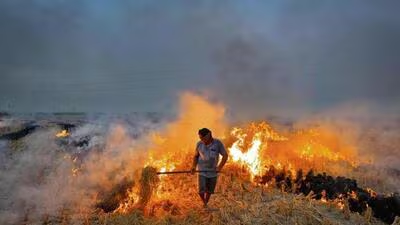
Every winter, Delhi struggles to breathe. This year is no exception. Children are kept indoors, schools face restrictions, outdoor workers continue their routines under hazardous conditions, and families wonder whether clean air has become a luxury. Almost on cue, attention turns to Punjab, where farmers burn paddy stubble after harvest—and the familiar cycle of accusations, emergency restrictions, and political recriminations begins again.
Fire counts do not establish how much pollution actually reaches Delhi; that depends on the area burned, emissions released, wind direction, weather conditions, and competing pollution sources. Does stubble burning adequately explain Delhi’s recurring air crisis? More importantly, can blaming farmers deliver cleaner air? It gives an impression that the problem has no solution. These figures demand attention, but also perspective. Stubble burning is a genuine environmental problem, yet it is not the principal driver of Delhi’s air crisis. Secondary particulates form through atmospheric reactions involving pollutants emitted by vehicles, industries, and power plants. Winter temperature inversions, weak winds, and reduced atmospheric mixing trap these pollutants near the ground. Weather aggravates the crisis, but the emissions themselves are overwhelmingly urban and industrial. these numbers separate seasonal triggers from the persistent emissions underlying Delhi’s deteriorating air While farm-fire contributions spike dramatically during specific pollution episodes. Eliminating crop-residue burning would bring vital relief, but it would not, by itself, give Delhi clean air.
The events of November 2026 underline the urgency of these questions. Delhi’s air quality index (AQI) hit 382 on November 6, prompting the Commission for Air Quality Management (CAQM) to impose Stage III restrictions. By the morning of November 11, the index stood at 299, still in the poor category. Meanwhile, Punjab recorded 5,002 satellite-detected farm fires between September 15 and November 10, up from 4,195 during the same period last year. In February 2026, CAQM reviewed an expert assessment drawing on source-apportionment studies conducted between 2015 and 2025. It identified secondary particulates as the largest contributor to Delhi’s winter PM2.5 pollution at roughly 27%, followed by transport at 23%, biomass burning (which includes sources beyond agricultural residue) at 20%, dust at 15%, and industry—including power plants—at 9%. A peer-reviewed 2024 study of Delhi’s Decision Support System reinforces this distinction. Looking at the 2021 post-monsoon period, it estimated that Delhi itself contributed an average of 34.4% to its PM2.5 levels, surrounding National Capital Region (NCR) districts contributed 31%, and agricultural biomass fires accounted for 7.3%.
Policy trap built on paddy Punjab, however, cannot ignore its own ecological predicament. Its rice–wheat production system was built to serve national food-security priorities. Assured procurement, minimum support prices (MSP), irrigation infrastructure, and subsidised electricity incentivised intensive cultivation. Punjab’s farmers delivered remarkably, securing the nation’s food grain stocks. Yet the environmental costs of this success are mounting. Water-guzzling paddy contributes significantly to this pressure. Paddy also leaves behind substantial volumes of straw that must be cleared within a narrow window before wheat sowing. Burning offers farmers a fast, inexpensive solution when machinery, labour, and collection services are unavailable or unaffordable. The practice is harmful and can’t be justified, yet enforcement alone cannot override the economic realities sustaining it. Why should an individual farmer bear the full cost of correcting an agricultural model dictated by public policy for decades? That question exposes the deeper failure: Fragmented governance. Agriculture departments focus on production; procurement agencies secure grain supplies; power utilities manage subsidies; environmental regulators issue fines; water boards warn of depletion; and district administrations scramble once the fields are already on fire. Each institution ticks its own boxes while their combined policies produce an ecological dead end. Breaking governance silos Solving this requires connecting these mandates rather than administering them in silos. Punjab should establish a five-year Clean Air and Sustainable Agriculture Compact, backed by the Union government and aligned with regional air-quality measures. Its goals must be measurable: Reducing crop burning, conserving groundwater, and protecting farm incomes. First, residue management must be accessible on the ground. Subsidising machinery fails if farmers cannot get functioning equipment during the tight harvest window. Village-level machinery banks, cooperative rentals, reliable collection networks, and direct incentives tied to verified non-burning deserve priority over one-off hardware subsidies. Second, crop residue must acquire economic value. Biomass energy, compressed biogas, and controlled industrial applications offer viable pathways—provided projects guarantee dependable procurement, timely payments, and genuine emissions reductions. Installed plant capacity means little if straw remains uncollected in the fields. Third, diversification requires credible alternatives to paddy. Farmers cannot reasonably walk away from assured procurement without dependable markets, processing infrastructure, and income protection. Region-specific crop choices, targeted price support, and a phased rollout are essential. Having benefited from Punjab’s food-security output for decades, the Centre must share the financial responsibility for this transition. Fourth, accountability must span the entire northern airshed. Delhi and neighbouring NCR jurisdictions must address vehicular emissions, industrial pollution, construction dust, waste burning, and the precursors to secondary particulates year-round—not just when AQI readings become alarming. CAQM already provides a statutory framework for regional coordination; what is missing is rigorous enforcement backed by shared targets, transparent data, and independent audits. Similarly, district administrations in Punjab should be judged on actual outcomes—verified burned area, residue utilisation, groundwater recovery, and net farm incomes—rather than tallies of inspections, fines, or machines distributed. Clean air must be treated as a continuous public-health responsibility, not a seasonal administrative emergency. Delhi’s residents should not have to endure toxic air every winter, nor should Punjab’s farmers serve as convenient scapegoats for pollution generated across a much wider region. Delhi needs clean air, and Punjab needs sustainable agriculture. The Government of India should develop a coherent policy that recognises both not as competing demands, but as shared national priorities. [email protected] The writer is a retired Punjab-cadre IAS officer. Views expressed are personal.
Punjab’s groundwater extraction in 2025 reached 156.36% of its annual extractable resources, with 111 of its 153 assessed blocks classified as over-exploited, according to data presented to Parliament.
