
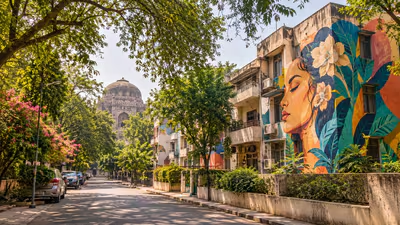
Today, it draws visitors for its street art and distinctive old-world charm. With its tree-lined streets, old government flats and colourful murals, Lodhi Colony is one of South Delhi’s most recognisable neighbourhoods. But behind its familiar streets lies a lesser-known story of how this part of the capital came to be.
By the mid-1950s, refugees had begun moving into vacant government flats in Lodhi Colony, as reported by Hindustan Times . Lodhi Colony’s origins can be traced to the early 1940s, when the Second World War brought significant changes to Delhi. Industrial and commercial activities expanded, more people moved to the capital for work, and government operations grew. This created a need for additional housing. This marked another change in the neighbourhood’s history, which had originally been developed to accommodate government employees. The Goethe-Institut’s account of Lodhi Art District traces how the initiative helped turn the neighbourhood into an open-air art gallery. Lodhi Colony has come a long way from being a government housing area during the war to becoming one of Delhi’s most popular street art destinations.
Lodhi Colony was among the last government housing neighbourhoods built during British rule in the 1940s, according to the Goethe-Institut .
