
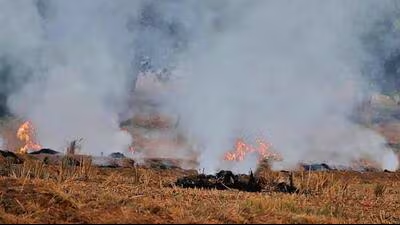
As the air quality deteriorates post-Diwali, stubble residue burning remains a major contributor to pollution in the region.
Haryana reported 14 new cases on Tuesday, crossing the 200 mark for the season and stood at 206 since September 15 till date, according to a consolidated report based on satellite data. The data also shows that almost half of the cases were reported in the last three days including a season-high of 80 on Sunday, the Diwali festival. However, the cases are nearly 43% less than the 363 reported during the same period last season. There were 981 cases of residue burning lodged in 2024. He said that Kaithal police have registered 18 cases against farmers for burning paddy residue so far. Kurukshetra deputy director of agriculture (DDA) Girish Nagpal appealed to farmers to avoid burning stubble and instead use in-situ and ex-situ management methods, for which the state government provides a subsidy of ₹ 1,200 per acre, to save the environment from pollution and maintain soil fertility.
Kaithal deputy superintendent of police (DSP) Ramesh Chander said superintendent of police Manpreet Singh Sudan, all DSPs and station in-charges have been encouraging prominent figures in villages and towns within their jurisdictions to refrain from burning crop residue. “The district administration, with police support, has been strictly monitoring farmers who burn crop residues and strict action is being taken against those found guilty,” he added.
On Tuesday, the maximum number of cases—three each—were reported from Sonepat and Jind, followed by two each in Kaithal and Karnal, while Ambala, Hisar, Jhajjar and Kurukshetra lodged one case each. Kaithal tops the chart with 65 cases so far, followed by 24 in Jind, 20 in Karnal, 18 in Kurukshetra, 17 in Palwal, 12 in Ambala, 11 in Fatehabad, seven in Hisar and Sonepat each, six in Hansi, five in Rohtak and Yamunanagar each, three in Sirsa, two in Panipat, two in Faridabad, and one in Jhajjar and Panchkula each, according to district-wise cases.
