
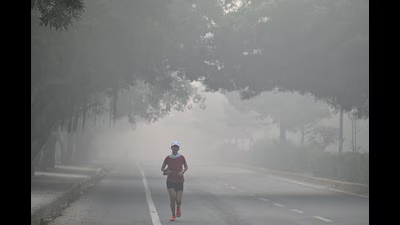
Air quality has shown marginal improvement in some parts of Haryana following the sharp pollution spike after Diwali, but residents of several cities, particularly those falling in the National Capital Region (NCR), continue to breathe polluted air, with the Air Quality Index (AQI) remaining in the very poor and poor categories.
The marginal improvement has provided little relief to residents as pollution levels continue to remain considerably above safe limits. The situation is particularly concerning in the NCR belt, where Gurugram, Faridabad, Bahadurgarh and Manesar continue to experience elevated pollution levels. Prolonged exposure to such conditions can cause respiratory discomfort and aggravate existing lung and cardiovascular ailments, particularly among children, elderly people and those with pre-existing health conditions.
Five cities recorded very poor air quality, with AQI levels above 300, according to the Central Pollution Control Board’s (CPCB) air quality bulletin for Tuesday. Kaithal reported the highest AQI of 336, followed by Gurugram (323), Sirsa (322), Hisar (316) and Kurukshetra (315). Another 15 cities remained in the poor category, with AQI readings between 201 and 300. Bahadurgarh recorded an AQI of 299, followed by Faridabad (290), Ambala (289), Manesar (284), Jind (276), Panipat (271), Charkhi Dadri (270), Fatehabad (242), Rohtak (235), Narnaul (228), Dharuhera (227), Palwal (226), Bhiwani (219), Sonipat (215) and Yamunanagar (205). Under the CPCB classification, an AQI of 201-300 falls in the poor category, while 301-400 is classified as very poor.
