
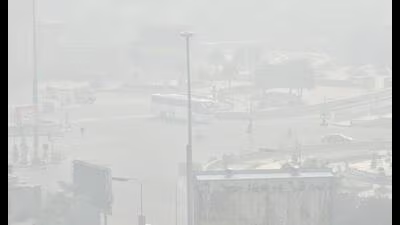
LUCKNOW A thick blanket of acrid smoke invaded living rooms and reduced midnight road visibility to a bare 200 metres on Sunday as unbridled firecracker bursting plunged Lucknow and much of Uttar Pradesh into a post-Diwali respiratory crisis.
While winds offered the state capital a breather by Tuesday — bringing the Air Quality Index (AQI) down to a ‘moderate’ 172 — the preceding 48 hours left asthma patients gasping.
“Lucknow witnessed a steady deterioration in air quality over a three-day period. Lucknowites claimed that the night sky turned smoky while visibility dropped significantly with haze all around. “In the name of green crackers, everything went up in the air. There should be some checks on crackers manufacturing units to see that not very poisonous chemicals are used in making crackers. We also recommend some kind of uniformity in cracker manufacturing and the material used in them. It is wrong to blame only the poor/uneducated for adding to the pollution by lighting fire crackers. Air quality deteriorated sharply across several cities in Uttar Pradesh. The post-Diwali deterioration was attributed to emissions from firecrackers and unfavourable weather conditions that can prevent pollutants from dispersing.
Its average AQI, based on readings from six monitoring stations, rose from 207 on November 7 to 233 on Diwali (November 8) and further to 245 on Monday. PM2.5 was the prominent pollutant,” an expert said analysing the CPCB data. On Tuesday (November 10), AQI in the state capital turned moderate at 172. But last year Diwali fell on October 20, nearly three weeks earlier. Since 2015, Lucknow’s air has been worse the day after Diwali than the day before it every year, according to the CPCB 4pm bulletins. A resident in Lucknow claimed that many people experienced a thick layer of smoke entering their living rooms on Diwali night while people could barely see anything beyond 200 metres on Diwali night while driving. On Diwali, AQI in Ghaziabad was 344 (’very poor’), Noida 318 (very poor), Greater Noida 299 (poor) and Meerut 295 (poor). On the following day (Monday), the AQI in Ghaziabad was 324 (very poor), Noida 332 (very poor), Greater Noida 252 (poor), Meerut 269 (poor), according to the Central Pollution Control Board (CPCB). An AQI between 201 and 300 is considered ‘poor’ and can cause breathing discomfort to most people on prolonged exposure, according to CPCB’s classification. The ‘very poor’ category, ranging from 301 to 400, can cause respiratory illness on prolonged exposure, even among healthy people. Khora in Ghaziabad district recorded the worst air quality in the state, with an AQI of 380, up from 364 on Diwali. Anpara in Sonbhadra district followed with 355, compared to 349 a day earlier. Noida recorded an AQI of 332, while Khurja’s reading jumped from 240 to 331. Ghaziabad (324), Baghpat (305), Gajraula (304) and Bulandshahr (303) were among the other cities in the ‘very poor’ category. Several cities witnessed a sharp deterioration in air quality within 24 hours of Diwali celebrations. Rae Bareli recorded one of the steepest rises, with its AQI jumping from 91 (‘satisfactory’) on Sunday to 218 (‘poor’) on Monday. Prayagraj’s AQI increased from 149 to 241, while Gorakhpur recorded a rise from 182 to 261. In Varanasi, the index climbed from 224 to 274. Moradabad also slipped from the ‘moderate’ category, with an AQI of 151, to the ‘poor’ category at 222. Fatehpur Sikri recorded an AQI of 203, compared to 110 on Diwali. Jhansi and Bareilly, however, remained in the ‘moderate’ category, with readings of 144 and 102, respectively. Other cities in the ‘poor’ category included Shamli (275), Meerut (269), Modinagar (260), Greater Noida (252), Muzaffarnagar (225), Kanpur (221) and Hapur (202). Meanwhile, Agra (187), Firozabad (176), Mathura (169), Pratapgarh (141) and Vrindavan (110) remained in the ‘moderate’ category. PM2.5, fine particulate matter that can penetrate deep into the lungs, remained the prominent pollutant across several cities. CSIR-IITR director Bhaskar Narayan said PM 2.5 can be severe as it can get mixed with the bloodstream While both the pollutants – PM 10 and PM 2.5 – can be harmful for health.
“The pollutants formed due to the burning of firecrackers are the cause of increase of air pollution in Lucknow, which may also be the cause of increased mortality and morbidity in urban areas.
AQI slipped to 233 on Diwali (November 8) and 245 the following day (November 9) – both were “poor” compared to last year’s Diwali’ AQI of 144, which was “moderate” followed by AQI 250 the following day, as per data from the Central Pollution Control Board (CPCB). In contrast (AQI.in), an open-source air quality monitoring platform created to provide real-time air pollution data and actionable health insight put Lucknow’s AQI at 1697 as “hazardous” on Diwali night at 11:11pm and 1470 on the same date at midnight. “Visibility had dropped to 1000 metres on Diwali midnight and it kept deteriorating with passage of time, and at 7am it dropped to 300 metres,” said a met official. We found that educated/rich people are more to be blamed,” said Shailendra Kumar Yadav, assistant professor in the department of environmental sciences, Babasaheb Bhimrao Ambedkar University, Lucknow. Individual bursting of firecrackers should be discouraged and community burning be promoted,” he said.
