
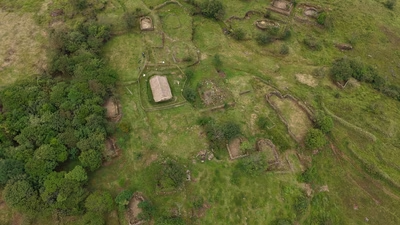
Nestled in Wahmawpat village along the road to Mawsynram in Meghalaya’s East Khasi Hills district, the ruins of Twahlongwar lie scattered across a rain-soaked hillside, their crumbling stone foundations and overgrown remains bearing witness to a long-abandoned Khasi settlement.
The project has introduced visitor pathways, signage and interpretation facilities, toilets, and a resting shed. Naphibahun, meanwhile, said she had one simple message to those who continue to call it the ‘Lost Village’. “Their orientation was likely influenced by the direction of the wind, the movement of the sun and the need for natural light and ventilation. One of the more intriguing findings was what Naphi believed was once a marketplace. Clusters of aligned orthostats, or upright stones, appeared to demarcate an area associated with trade and exchange. Archaeological observations, together with oral accounts, suggest that Twahlongwar may have maintained trading connections with neighbouring settlements such as Balat and Hatmawdon, located not far from the Indo-Bangladesh international border. Megalithic remains in surrounding villages also point towards a wider network of interactions and possible trade routes. Researchers came across iron tools during the site’s clearing, although Lyngdoh clarified that no evidence of iron smelting had been found. “The biggest challenges were heavy rainfall, water erosion, overgrown vegetation and difficult terrain. Drone surveys, Geographic Information System (GIS) mapping and digital terrain modelling have supported the conservation work by providing a detailed digital record of the settlement and its surrounding landscape for future research. The guiding principle has been to preserve rather than extensively reconstruct, retaining the authenticity of the surviving remains. The project has also revamped an existing dam to improve water storage. “Seeing the community reconnect with its heritage has been the most rewarding part of the project. For residents of Wahmawpat and neighbouring villages, the transformation has been particularly gratifying. Stimil Mawleiñ pointed to the economic opportunities emerging from the initiative. Twenty-five residents have been trained as tour guides, while others have started setting up shops and exploring opportunities under the homestay scheme of the state government. Local people also helped develop the site. Beyond livelihoods, Sdingson Nongsiej believes they must record the stories before they disappear. “The stories of elders should be recorded through interviews, photographs and audio or video documentation. Phrangsngi Marngar hopes the interest in the settlement would translate into lasting benefits for the village. “I see tourism as a positive opportunity for the village. Twahlongwar’s appeal extends beyond the local community. Dr Mark Elliott, senior curator in anthropology at the Museum of Archaeology and Anthropology, University of Cambridge, visited the settlement when Naphibahun Lyngdoh was working on a project in Cambridge. Impressed by what he encountered, Elliott offered a telling endorsement: “This is the kind of place I would send my students to learn. “We are focusing on awareness and capacity building through ongoing training for the local community and tour guides. MAL is also working towards publishing a book documenting oral histories and narratives associated with the settlement, an effort to preserve memories that might otherwise disappear with the older generation. The long-term ambition is to incorporate Twahlongwar into a wider heritage circuit connecting archaeological and cultural sites across Meghalaya. “Twahlongwar has shown that heritage conservation can go hand in hand with community participation and sustainable tourism. For MAL, the initiative is about demonstrating that Meghalaya’s heritage is as valuable a resource as its natural beauty. For the community, it is an opportunity to reclaim a forgotten part of its identity. And for researchers, the settlement offers a wealth of unanswered questions waiting to be investigated.
Investigations identified 21 ruined houses, many with distinctive apsidal forms and a predominantly north-east-facing orientation. The project has involved an investment of approximately ₹ 63 lakh, covering archaeological work, conservation, infrastructure development and community engagement.
This suggests that people had a good understanding of their surroundings and positioned their homes accordingly,” Lyngdoh said. We also had to be careful in choosing appropriate conservation methods to stabilise the structures while retaining their original character,” she said. It is particularly meaningful to see residents take pride in a place that was once largely overlooked,” she said. Jminmera Nongsiej said people of all ages have become increasingly curious about their village’s past. “The project has created several livelihood opportunities for the local community,” Stimil said. “We have trained 25 local tour guides, residents have started setting up their own shops, and some are now applying for the homestay scheme,” said Philaris Nongsiej. Younger generations should also be involved in preserving and sharing this knowledge,” Sdingson said. My hope is that it will create more livelihood opportunities, encourage people to take pride in their heritage and provide a sustainable source of income,” Phrangsngi said. Robert G Lyngdoh, MAL’s chief administrative officer, said the vision was to establish Twahlongwar as an important heritage destination that combines archaeological conservation with community participation and responsible tourism. Visitors are encouraged to explore the site through guided tours, and they are not allowed to step on or disturb the archaeological structures,” he said. Every site, however remote or overlooked, has a story worth documenting and preserving,” Robert Lyngdoh said. “It is not lost; it is still very much there, simply abandoned.”
A history still waiting to be unravelled
For decades, locals considered the site little more than the remnants of old houses. How old is Twahlongwar, and why was it abandoned? These questions continue to occupy researchers. A trial trench yielded a small quantity of charcoal, which was sent for radiocarbon analysis. The findings suggest a possible 18th-century or later association, although they do not establish a definitive date for the settlement. Further examination of the archaeological context and the complete calibrated probability distribution is necessary. No archaeological evidence explains why the inhabitants eventually abandoned the settlement. Lyngdoh believes limited natural resources may have made sustained habitation difficult. Another possibility is that the construction of the Mawsynram road during the British period made movement and access to other areas easier, prompting relocation. Conserving the settlement has been as challenging as documenting it. Heavy rainfall, water erosion, overgrown vegetation, and difficult terrain posed formidable obstacles, especially where exposed archaeological structures are vulnerable to the elements. One of them, Larnel Lyngdoh, recalled that people viewed the ruins simply as remnants of old houses.
Twahlongwar, locally known as ‘Shnong Ba la Jah’ (The Lost Village), has become an open-air archaeological museum, drawing 2,115 visitors, researchers and heritage enthusiasts since it opened in August. Under Naphi’s stewardship, MAL undertook approximately 14 months of experimental conservation, testing materials such as sand, lime and pine needles to identify methods suited to the local environment.
Philorian Nongsiej welcomed the archaeological attention, observing: “The more we learn about our history and heritage, the better.” Today, however, its archaeological significance is drawing visitors, researchers and history enthusiasts, transforming an overlooked landscape into a distinctive heritage destination.
She first came across the site in 2019 when a friend took her to Twahlongwar. The systematic archaeological documentation of the site, mostly covered in vegetation, with several collapsed houses and exposed stone structures, began only in 2022. “Locally, the place was already known as the ‘Lost Village’, which sparked my interest in exploring its archaeological significance.
The state-run Meghalayan Age Limited (MAL) conceptualised and executed the initiative, bringing together archaeological investigation, digital documentation, experimental conservation and community participation. Archaeologist Naphibahun Lyngdoh, senior manager for heritage and conservation at MAL, led the effort. Discovering the ruins of the settlement amazed me the most,” she recalled. Yet the project is far from complete. Further archaeological investigations, scientific dating, archival research, and detailed studies of individual structures will take years. For Naphi, however, the most rewarding aspect has been witnessing the community reconnect with a heritage that was once largely overlooked.
