
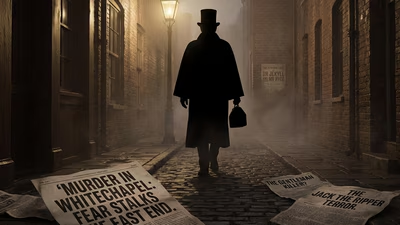
London, 1888. Fear had taken hold of the East End. Five women had been brutally murdered, the killer remained at large, and the police had little to show for their investigation. With the killer still at large and Scotland Yard struggling to make progress, London’s newspapers began shaping the story of a mysterious murderer who would become one of history’s most infamous figures: Jack the Ripper.
The Whitechapel murders gripped Victorian London, with reports of mutilated bodies, mysterious suspects and unanswered questions dominating newspapers. The story soon spread. A BBC retrospective, based on original Home Office files, later examined how sensational newspaper coverage fuelled myths that misled both the public and the police. The similarities between fiction and the murders became so striking that Richard Mansfield, the American actor playing Jekyll and Hyde, was suspected of being the killer. A concerned theatregoer even wrote to the police suggesting that Mansfield could be Jack the Ripper . After the murder of Polly Nichols, the Observer sent a reporter to view her body. describing how Nichols’ ‘livid face was stained with blood and her throat cut from ear to ear’, the Observer offered a more restrained account: ‘The features were small and delicate, with the cheek-bones high, the eyes grey … The expression on the face was a deeply painful one While the Illustrated Police News sensationalised the killing. Stead was experimenting with a sensational style of reporting that would later become associated with tabloid journalism. He also reportedly had a long-running grievance against Metropolitan Police Commissioner Sir Charles Warren, whom he blamed for what he considered a wrongful conviction and the excessive use of force against protesters. The murders gave Stead an opportunity to criticise the police while drawing attention to prostitution, poverty and the exploitation of women.
At the time, the Lyceum Theatre was staging an American production of The Strange Case of Dr Jekyll and Mr Hyde . Its business manager was Bram Stoker, who would later write Dracula . On November 9, 1888, Mary Jane Kelly, widely regarded as the fifth and final canonical victim of Jack the Ripper, was murdered in London’s East End.
