
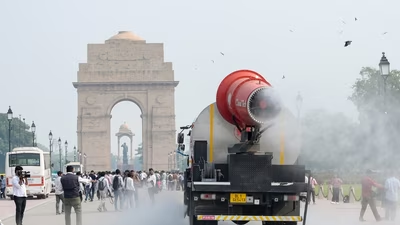
Delhi’s air quality remained in the “very poor” category even as the AQI reading showed a slight improvement on Tuesday, while the minimum temperature remained relatively high for this time of the year in the national capital.
Visibility conditions improved at both airport weather stations. Despite the marginal dip, pollution levels remained a concern. The air quality index (AQI) stood at 304 on Tuesday, in the ‘very poor’ category, indicating a slight improvement from the previous day. At 9 am, PM 2.5 was the leading pollutant at 51 of the 57 monitoring stations. At least 29 monitoring stations had AQI in the poor category, while two stations—Sri Aurobindo Marg and Delhi Cantonment—recorded AQI values of 161 and 170, respectively. The 24-hour average AQI on Monday was recorded at 344. NASA’s satellite detected 3,577 farm fires in Punjab and Haryana from October 1 to November 9 (Punjab: 3,240; Haryana: 337), with324 of them on November 9. Over the same dates last season, it counted 3,629. Burning has shifted later each year (98% of the fire heat Meteosat recorded in 2025 occurred after 3pm, compared with 94% in 2024), so the two counts can differ for that reason alone, according to HT’s analysis. Safdarjung recorded a minimum temperature of 15.7°C, 1.4 degrees above the seasonal normal, according to India Meteorological Department (IMD) data. The reading was 0.4 degrees lower than Monday’s minimum. Lodhi Road recorded a minimum of 16.4°C, 4.4 degrees above normal, the highest departure among the five weather stations. Palam recorded 16.5°C, 1.3 degrees above normal, while the Ridge logged 16°C, 0.3 degrees below normal. Ayanagar’s minimum temperature stood at 16.4°C, 0.9 degrees above normal. At Safdarjung, visibility stood at 1,000 metres at 8am on Tuesday, against 100 metres on Monday, when dense fog was reported. The lowest visibility during Tuesday’s fog episode was 500 metres at 6.30am, with mist reported at 8am. At Palam, visibility improved to 800 metres from 600 metres on Monday, with shallow fog reported. Visibility at both stations remained above 500 metres during the morning observations. No rainfall was recorded at any of the five IMD weather stations in Delhi in the 24 hours ending 8.30am on Tuesday.
Because most of the burning now occurs after the satellite passes, at about 1.45pm, both are undercounts.
The CPCB classifies an AQI between 0 and 50 as “good”, 51 and 100 as “satisfactory”, 101 and 200 as “moderate”, 201 and 300 as “poor”, 301 and 400 as “very poor”, and 401 and 500 as “severe”.
