
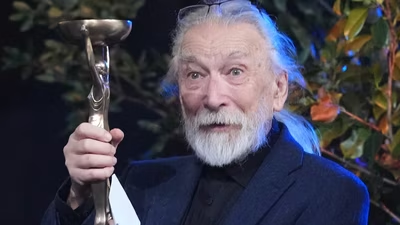
British author M John Harrison has won the 2026 Booker Prize for his novel ‘The End of Everything’, becoming the oldest writer to receive the prestigious literary honour at the age of 81. Harrison was announced as the winner at a ceremony in London on Monday beating five other shortlisted authors to claim the £50,000 (approximately ₹ 62 lakh) award.
Atwood shared that year’s award with British writer Bernardine Evaristo, who won for Girl, Woman, Other. Harrison was selected from a shortlist of six novels, which included two authors who had previously won the Booker Prize. Harrison became the first writer from the established science fiction community to win the Booker Prize . His novel, a dystopian satire set in a post-apocalyptic Britain, was selected unanimously by the judging panel chaired by historian and classicist Mary Beard. Set along England’s Kent coast in a post-apocalyptic future, The End of Everything centres on Phillip Tennent, who lives with his elderly aunt, Marnie, and makes a living scavenging along the shoreline. Their existence is disrupted when Phillip discovers a mysterious object that can change shape. The discovery comes amid the appearance of strange beings called the iGhetti. Blending science fiction, dystopia and satire, the novel portrays a society struggling to make sense of an unexplained disaster. It also touches on contemporary anxieties surrounding artificial intelligence, technology and political uncertainty. His win has brought renewed attention to the place of science fiction within mainstream literary recognition. Jamaican writer Marlon James was shortlisted for The Disappearers. Scottish-American author Douglas Stuart, another former winner, was nominated for John of John. The other shortlisted writers were American author Elizabeth Strout for The Things We Never Say, British poet and novelist Luke Kennard for Black Bag, and Rebecca Perry for May We Feed the King. The judges selected Harrison’s novel unanimously. Harrison grew up in an engineering family and initially had little encouragement to pursue writing as a career. His interest in literature developed through extensive reading, with works by authors such as Samuel Beckett, Thomas Pynchon and George Bernard Shaw. Harrison also spent around two decades pursuing rock climbing, an experience that informed much of his writing. Beyond fiction, Harrison has worked as a literary critic and reviewer, contributing to publications including The Guardian, The Daily Telegraph, The Times Literary Supplement and The New York Times. It is open to authors of any nationality, provided their eligible works are originally written in English and published in the UK and/or Ireland.
Harrison breaks the previous age record held by Canadian author Margaret Atwood, who was 79 when she jointly won the Booker Prize in 2019 for The Testaments. The 2026 award also recognises Harrison’s writing career, which spans six decades. The End of Everything is his 13th novel and was the shortest book on this year’s shortlist, at 198 pages. James won the award in 2015 for A Brief History of Seven Killings. He received the prize in 2020 for his debut novel Shuggie Bain. The 2026 judging panel was chaired by Mary Beard and included poet Raymond Antrobus, musician and writer Jarvis Cocker, journalist Rebecca Liu and novelist Patricia Lockwood. Each of the five other shortlisted authors receives £2,500 (over ₹ 3 lakh), while Harrison takes home the main prize of £50,000. Born in 1945 in Rugby, Warwickshire, England, Michael John Harrison, better known as M John Harrison, is a British novelist, short-story writer and literary critic whose career spans six decades. He sold his first story in 1965 and joined the staff of the influential speculative fiction magazine New Worlds in 1969, where he edited the books section until 1978, according to the Booker Prize Foundation. In a 2012 interview with The Guardian, he recalled feeling alienated at school and described writing as an escape. His other major works include The Course of the Heart (1992), Signs of Life (1996) and the science fiction trilogy comprising Light (2002), Nova Swing (2006) and Empty Space (2012). Nova Swing won the Arthur C Clarke Award in 2007, while Light received the James Tiptree Jr Award in 2002. His 2020 novel The Sunken Land Begins to Rise Again won the Goldsmiths Prize, which recognises innovation in fiction. He also published the short-story collection You Should Come With Me Now in 2017 and the autobiographical work Wish I Was Here in 2023. Established in 1969, the Booker Prize is among the most prominent literary awards for fiction written in English. The inaugural award went to British author P H Newby for Something to Answer For in 1969. The prize was initially restricted to writers from the Commonwealth, Ireland and other eligible territories, before its eligibility rules were expanded in 2014 to include authors from anywhere in the world.
The judging panel’s chair, Mary Beard, described the novel as “the politics of now seen through the lens of the future”. Explaining the panel’s decision, Beard said: “It’s a book that turns you upside down, raises a wry smile — and surprisingly, given the subject matter, leaves you with a twinge of optimism. He said the Booker recognition demonstrated that “the era of genres as fences and boxes, pigeonholes, is over,” as per AP. He has also co-written fantasy novels about talking cats and ghostwritten a book on behalf of a prominent British rock climber, according to the Booker Prize Foundation.
Harrison, who has spent much of his career working across speculative and literary fiction, previously resisted the idea of restricting his writing to a single genre.
