
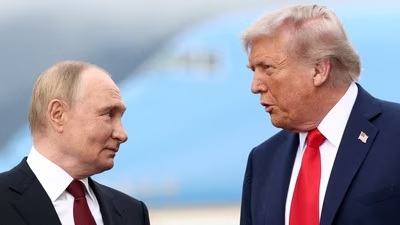
In the case of Russia’s invasion of Ukraine, he has made similar announcements at least three times. The negotiations are due to begin on November 10th in Abu Dhabi.
IT WAS NOT the first time Donald Trump announced a “big, beautiful agreement” to end a war.
But his most recent remarks, delivered just days before the start of the first trilateral talks between Russia, Ukraine and America since February, have set alarm bells ringing in Kyiv and in parts of Europe.
Few believe a window for serious diplomacy has opened. But insiders in America and Ukraine report that President Trump’s heavy defeat in the midterm elections has injected a new urgency into the process. The arrival of Democratic majorities in the two houses of Congress in January offers a firm deadline to his main negotiators, Steve Witkoff and Jared Kushner, who could soon face investigations over alleged conflicts of interest. Ukrainian negotiators are privately sceptical of a breakthrough, but have been instructed to approach the talks with an open mind, if only to avoid annoying Mr Trump. The Americans have already offered several controversial sweeteners to coax Mr Putin into a deal. One is to plug Russia back into European energy markets—in contravention of a new European Union law. Both Ukraine and its European partners are resisting this proposal. Ukrainian and European officials say they fear that America’s offer to include talks about Europe’s own security arrangements will give Russia new levers to pull to delay agreeing to a ceasefire. They argue that a ceasefire should come before any conversation about Europe’s future security. All the same, it is hard to see how simply reforming a NATO council could satisfy Mr Putin and his well-publicised desire to see Russia dominating eastern Europe in the way that the Soviet Union once did.
But the Americans disagree, and seem to take a position close to the one Mr Putin has held since the eve of his invasion in 2022: that the war in Ukraine cannot end without discussion of Europe’s future security arrangements.
“Not a chance of us agreeing to that while the war is still raging,” says a Ukrainian official. Another idea, according to people involved in the talks, is a cartographic fudge: to redraw Ukraine’s administrative boundaries to allow Russia to claim full control of the Luhansk and Donetsk regions it wants to conquer without Ukraine surrendering the remaining cities it holds. A source close to the White House says the model for this new architecture could be a reworked NATO-Russia Council. It was not wrong to try to imagine “what comes after”, the source added: “Nobody has been able to solve this conflict while everyone is telling the US how [to do so]. In a briefing ahead of the talks, an American official said any new arrangement would respect national sovereignty, with NATO “remaining central to European collective defence”.
