
India and the European Union (EU) on Monday reviewed efforts aimed at the timely signing and implementation of a free trade agreement and to conclude an investment protection agreement and an agreement on geographical indications.
The two sides expressed satisfaction at deepening research collaboration, including India’s potential association with Horizon Europe, the EU’s €93.5-billion flagship research and innovation programme.
India and the EU reviewed engagements aimed at boosting trade and investment cooperation, including the “timely signing and implementation of the India-EU Free Trade Agreement”, and to conclude the investment protection agreement and the agreement on geographical indications, both sides said in a joint statement. They agreed to enhance coordination and cooperation towards shaping effective global governance, the statement said. “As trusted, predictable and like-minded partners, they reaffirmed their commitment to deepen the India-EU Strategic Partnership, and to deliver mutually beneficial, concrete and transformative outcomes,” the statement said, adding that the meeting also reviewed preparations for future meetings at the leaders’ level. Both sides welcomed the “very positive momentum” in India-EU relations, and reviewed the implementation of the joint comprehensive strategic agenda adopted at the India-EU Summit in New Delhi in January.
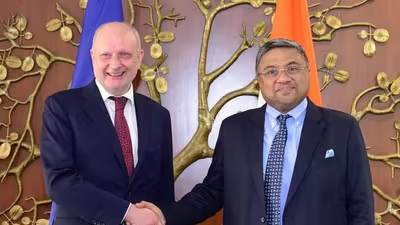
The conclusion of negotiations for India’s association with the programme was announced by both sides last week. These matters figured at an India-EU strategic partnership review meeting held in New Delhi, weeks ahead of an expected visit by Prime Minister Narendra Modi to Brussels in mid-December for the signing of the FTA. The two sides concluded negotiations for the trade deal in January. The discussions also covered strengthening supply chains and economic security, including strategic engagements in the Trade and Technology Council (TTC) and Blue Valleys initiative. The meeting, co-chaired by Sibi George, secretary (West) in the external affairs ministry, and Matti Maasikas, deputy secretary general for geoeconomics and inter-institutional issues of the European External Action Service, also discussed cooperation in critical and emerging technologies, including artificial intelligence (AI), quantum technologies, digital public infrastructure (DPI), advanced semiconductors, clean tech and biotechnology, as well as engagements to advance a conducive digital environment and promote DPI. The two sides emphasised the importance of strengthening connectivity partnership, including Global Gateway, India-Middle East-Europe Economic Corridor (IMEC) and trilateral projects in clean energy, climate resilience, green mobility and digitalisation. The meeting discussed ways to enhance people-to-people contacts, including in talent mobility, education and skills development, and reviewed updates on the European Legal Gateway Office. They also looked forward to the next edition of the India-EU human rights dialogue. They further renewed their commitments to advance the clean transition, and to pursue cooperation to include Indian ship recycling yards that comply with the EU Regulation on Ship Recycling in the bloc’s list of ship recycling facilities.
