
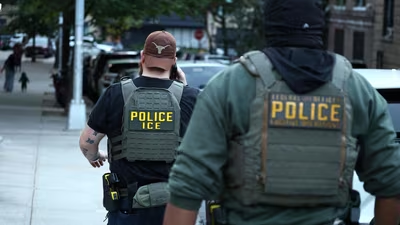
A California man, who was shot by a federal immigration officer during an ICE enforcement operation, has filed a lawsuit seeking more than $25 million in damages, accusing federal agents of excessive force, wrongful prosecution and the fabrication of evidence, Newsweek reported.
Jimenez also faced federal criminal charges following the incident. Prosecutors accused him of assaulting a federal officer by using his vehicle, and a grand jury returned an indictment on November 18, 2025.
The complaint names the Trump administration, ICE officer Eusebio Ortiz, two Customs and Border Protection officers identified as N. Jimenez and S. Cosey, FBI Special Agent Estevan R. Banuelos, and San Bernardino County. He allegedly approached federal agents to alert them that children would soon be waiting at a nearby school bus stop. The complaint claims that as he attempted to leave the area, an officer shot him in the back and shoulder. The Department of Homeland Security ( DHS ) has offered a different version of events. Jimenez’s attorney has challenged that explanation, maintaining that his client was carrying out a three-point turn after complying with the officers’ instructions. The complaint alleges that Ortiz initially aimed his firearm at Jimenez and threatened to shoot him if he did not leave. The officer allegedly put the weapon away and displayed pepper spray before firing multiple shots through the rear passenger-side window of Jimenez’s Lexus as he attempted to turn around. Jimenez sustained several gunshot wounds, along with a displaced fracture of his right shoulder blade. The lawsuit further states that bullet fragments remained inside his torso near his right lung.
Carlos Jimenez submitted the 54-page lawsuit on November 6. It also lists 20 unidentified people as defendants. Because he feared being struck by the vehicle, an ICE officer allegedly fired in self-defense.
Jimenez was not the intended subject of the immigration operation, according to the lawsuit. A DHS spokesperson previously told Newsweek that Jimenez parked his vehicle in front of ICE officers and was instructed to move away. His vehicle then reversed toward the officers, creating what the spokesperson described as an immediate threat, according to the department. The lawyer says Jimenez had started moving forward when the officer opened fire.
The criminal proceedings later involved a dispute over evidence and communications belonging to federal officers. District Judge Kenly Kiya Kato directed the government to disclose relevant communications and operational records requested by the defense. The order covered messages exchanged through both official government devices and personal phones. It also required Ortiz to submit a sworn declaration if no relevant communications from him could be located. Jimenez subsequently entered a diversion agreement. However, the dismissal did not establish that the officers had used unlawful force or committed misconduct.
On May 5, U.S. After completing its requirements, his criminal indictment was dismissed with prejudice by Judge Kato on November 2, preventing prosecutors from bringing the same charges again.
Since Donald Trump returned to the White House on January 20, 2025, at least 32 shooting incidents involving federal immigration enforcement personnel have been documented nationwide, according to The Trace’s ICE shootings tracker. Those incidents have reportedly resulted in at least nine deaths and 15 injuries. In February 2026, two ICE officers were suspended and investigated after DHS said video evidence appeared to contradict statements they had made under oath concerning a shooting in Minneapolis. Separately, a ProPublica investigation published in October 2026 identified more than 500 U.S. citizens who had reportedly been detained by federal immigration authorities since Trump’s return to office. Jimenez’s lawsuit contains 13 causes of action, including claims of excessive force, false arrest, malicious prosecution and inadequate medical care. He is seeking $25 million in non-economic damages, in addition to approximately $179,000 for medical bills, lost earnings, property damage and other financial losses.
Following the shooting, he was transported to Riverside Community Hospital for emergency trauma treatment. The complaint also raises concerns about how federal investigators allegedly handled Jimenez while he was receiving medical attention. It claims FBI agents removed him from his hospital bed, secured him with handcuffs and a leather waist restraint, and transported him back to the shooting location for questioning. The lawsuit alleges that Jimenez continued bleeding and vomiting inside the agents’ vehicle and was instructed not to damage it. He was subsequently transferred to West Valley Detention Center. The complaint accuses authorities of failing to provide appropriate medical treatment and necessary medication despite his injuries. The Justice Department stated that diversion had been requested by Jimenez and that prosecutors sought dismissal after he fulfilled the agreement’s conditions. During the criminal case, the government also maintained that the text messages requested by the defense did not exist. Another major allegation in the civil lawsuit concerns FBI Special Agent Estevan R. Banuelos, whom Jimenez accuses of falsifying information in investigative reports. The complaint alleges that Banuelos prepared an interview report attributing statements to two individuals, Manuel Villareal and Beatrice Morales. However, the lawsuit claims that both individuals later gave different accounts to an investigator working for the defense. They allegedly denied providing any estimate of the available distance or saying that Jimenez had enough room to drive forward. The complaint further argues that prosecutors offered Jimenez a diversion arrangement to avoid having Banuelos questioned under oath and to prevent further scrutiny of evidence concerning Ortiz’s phone communications. These allegations have not been established through a court finding. The case comes amid increasing scrutiny of the use of force by federal immigration officers during the Trump administration’s deportation campaign. Federal immigration agencies have also faced legal challenges and public criticism over allegations of excessive force, racial profiling, unlawful detention and violations of constitutional protections. In several enforcement-related cases, video recordings and witness accounts have reportedly raised questions about the accuracy of official explanations. The civil case will examine the allegations surrounding the shooting, the subsequent investigation, the treatment Jimenez received while in custody and the evidence used in his criminal prosecution. The allegations remain claims made by the plaintiff, and the lawsuit’s filing does not constitute a judicial determination that the defendants are liable.
This happened while bullets and fragments were still lodged in his body, according to the filing. The witnesses indicated that Jimenez had sufficient space to move his vehicle forward instead of reversing, according to the report. They also reportedly said they had not witnessed the actual shooting.
