
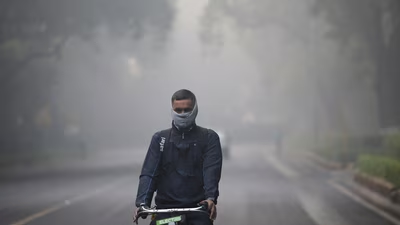
Delhi woke up to another spell of heavy pollution on Monday, a day after Diwali celebrations, as firecracker emissions added to the national capital’s already deteriorating air quality. The Air Quality Index (AQI) on Monday morning stood at 366 under ‘very poor’ category as of 6:15 am, as per the Central Pollution Control Board (CPCB)’s Sameer app and HT Pollution Dashboard.
The Capital also witnessed reduced visibility. Both readings were in the ‘very poor’ category. The city’s average AQI stood at 376 on Sunday, in the ‘very poor’ category, compared with 369 a day earlier. The average PM2.5 concentration across 39 monitoring stations that also reported data last Diwali rose from 190 µg/m³ in the 15-minute period beginning at 7.45pm to 259 µg/m³ from 8pm, according to an analysis of the Central Pollution Control Board’s (CPCB) 15-minute records by HT. The 8pm average was more than four times India’s 24-hour PM2.5 standard of 60 µg/m³. At 5.30pm, Delhi’s air quality was already in the ‘very poor’ category, even before firecrackers were burst in large numbers. The overall AQI stood at 376, under the ‘very poor’ category. Of the 59 monitoring stations, 12 recorded air quality in the ‘severe’ category, while 22 reported ‘very poor’ air quality. The Air Quality Early Warning System (EWS) for Delhi had forecast that air quality was likely to deteriorate to the ‘severe’ category from November 9 and remain there for the next few days. By 7pm, the city’s AQI stood at 371, in the ‘very poor’ category. Of the 59 monitoring stations, 19 were in the ‘severe’ category, seven in the ‘poor’ category and the remaining 33 in the ‘very poor’ category. At 9pm, Delhi’s AQI, according to official data, stood at 370, while the HT Pollution Dashboard reported it at 389. Most of these additional stations recorded cleaner air, pulling the official average down by 19 points. By 10pm, the city’s AQI stood at 371, under the ‘very poor’ category, according to the CPCB. Of the 59 monitoring stations, 20 were in the ‘severe’ category, 33 reported ‘very poor’ air quality and six were in the ‘poor’ category. Sonia Vihar recorded the highest AQI at 463, placing it in the ‘severe’ category. The CPCB classifies an AQI of 0-50 as ‘good’, 51-100 as ‘satisfactory’, 101-200 as ‘moderate’, 201-300 as ‘poor’, 301-400 as ‘very poor’ and 401-500 as ‘severe’.
Because the official AQI calculation includes 20 more monitoring stations than the HT Pollution Dashboard’s comparison of stations that reported data last Diwali, the difference in the figures is.
Delhi’s air quality deteriorated sharply by 8pm on Diwali night as firecrackers began bursting across the city, according to the HT Pollution Dashboard. Several people took to social media to report smelling smog and firecracker smoke in the air, while others flagged reduced visibility, according to a PTI report.
It also pointed out that restrictions had repeatedly been violated, with conventional crackers being sold under the guise of green firecrackers. The court observed that while firecrackers undoubtedly contributed to pollution, measures taken by authorities, either following judicial directions or on their own, had failed to achieve the desired results. It stressed that the problem lay in implementation and called for better coordination among stakeholders and sustained monitoring beyond the festive season. The development brought the focus back on enforcement even as the court had relaxed its blanket prohibition. Weather and air quality experts have attributed the anticipated deterioration in air quality to a combination of vehicular emissions, Diwali-related celebrations and the peak stubble-burning season in neighbouring states. Unfavourable weather conditions are further aggravating the situation by slowing the dispersal of pollutants.
The Supreme Court on November 2 allowed the sale and bursting of certified green firecrackers in Delhi-NCR between 6am and 7am and 8pm and 10pm on November 7 and 8, ahead of Diwali. The court, however, made it clear that a complete ban on firecrackers would be reinstated from November 9. On November 3, the Supreme Court, taking note of a Hindustan Times report exposing the open sale of conventional and unauthorised firecrackers in Delhi markets, asked the law officer to look into the matter and ensure that necessary measures were taken. PM2.5 was the predominant pollutant in Delhi on Sunday, with emissions from firecrackers adding to the particulate matter in the air. The transport sector was the biggest contributor to the city’s pollution on Sunday, accounting for 19% of the total, according to the Decision Support System (DSS) for Delhi. Stubble burning accounted for an estimated 3.5%, with its contribution forecast to fall to around 2.99% on Monday. A ventilation index below 6,000 square metres per second, combined with an average wind speed of less than 10 kilometres per hour, makes it difficult for pollutants to disperse, according to the Air Quality Early Warning System (EWS).
A bench of justices MM Sundresh and PB Varale said it was opting for a regulated approach rather than a blanket prohibition, noting that the earlier complete ban had neither significantly improved air quality nor prevented the illegal sale and use of conventional firecrackers.
